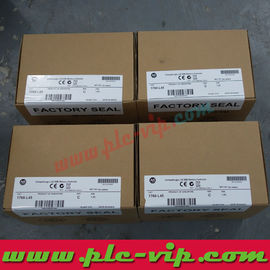
Allen Bradley PLC 1768-M04SE / 1768M04SE
-
-
Large Image :
Allen Bradley PLC 1768-M04SE / 1768M04SE
|
Product Details:
| Place of Origin: |
Made in SINGAPORE |
| Brand Name: |
Rockwell |
| Certification: |
All goods we supply are 100% original factory sealed with 1 year warranty! |
| Model Number: |
Allen Bradley PLC 1768-M04SE / 1768M04SE |
Payment & Shipping Terms:
| Minimum Order Quantity: |
1 /PCS |
| Price: |
$435.00 (USD/PCS) |
| Packaging Details: |
100% original new |
| Delivery Time: |
IN STOCK; 4-6 weeks for ordering |
| Payment Terms: |
Paypal, T/T and Western Union. |
| Supply Ability: |
10 PCS |
|
Detailed Product Description
 1768-M04SE / 1768M04SE SERCOS Interface Module
Category:
PLCs, Power Supplies & I/Os
Manufacturer:
Rockwell
Group:
PLC Module
The 1768-M04SE is the SERCOS interface module for the 1768 CompactLogix backplane: four drive axes and two auxiliary feedback axes, fiber optic ring, 5.04 W of power consumption.
It is the motion option for an L43, L45, L43S or L45S — the controller has no motion port of its own, so a SERCOS ring of drives is reached through this module in one of the backplane slots.
Product Specifications 1768-M04SE (PDF)
Application |
SERCOS interface motion module for the 1768 backplane |
Cat Num |
1768-M04SE |
Brand Name |
Rockwell |
Axes per module, max |
4 drives and 2 auxiliary feedback axes |
Communication |
SERCOS interface, IEC 61491, fiber optic |
Fiber range, plastic cable |
1…32 m |
Fiber range, glass cable |
1…200 m |
Power consumption |
5.04 W |
Power supply distance rating |
2 modules |
Height |
132.15 mm |
Mounting screw torque |
1.16 N·m, M4 or #8 |
Attribute values above are reproduced from the manufacturer's product data. For the authoritative technical record see Rockwell publications 1769-TD006 (module specifications) and 1769-SG001 (installation instructions). Certification details, with certificate and file numbers, are listed in the FAQ below.
Axes and what they mean
Four drives plus two auxiliary feedback axes.
Per module, not per system.
SERCOS interface to IEC 61491. The ring is deterministic and digital; drive parameters are configured in the programming software rather than by discrete wiring.
Fiber optic ring
Plastic fiber 1...32 m.
Glass fiber 1...200 m.
Fiber, not copper.
Power and backplane placement
5.04 W of power consumption.
Supply distance rating 2 modules.
132.15 mm height, 1.16 N·m screws.
Selection notes
1768-M04SE is a 1768 module.
Integrated motion is a different path.
Check the drive side.
Motion versus integrated motion
Two motion architectures in the CompactLogix range.
The module is the axis budget.
Power and thermal check before the order.
FAQ — 1768-M04SE
How many axes does the 1768-M04SE support?
Four drive axes plus two auxiliary feedback axes per module, to the SERCOS interface standard IEC 61491.
What fiber cable does the 1768-M04SE use?
Plastic fiber from 1 to 32 m, or glass fiber from 1 to 200 m, on the Tx and Rx ports.
How much power does the 1768-M04SE consume?
5.04 W, with a power supply distance rating of two modules on the 1768 backplane.
How many 1768-M04SE modules fit in one controller?
Two motion modules on the 1768-L43 and L45, four on the L43S and L45S; the 1768 backplane accepts a maximum of four 1768 modules in total.
Which controllers take the 1768-M04SE?
The 1768-L43, L45, L43S and L45S, in a 1768 backplane slot next to the communication modules.
Is the 1768-M04SE the same as integrated motion?
No. It is a SERCOS interface module; integrated motion over EtherNet/IP is the 5370 controller approach and needs no motion module.
Why SERCOS rather than analog drive references?
SERCOS carries position, velocity and status digitally over a fiber ring, so a drive follows a commanded profile instead of an analog reference that drifts and picks up noise.
How far can the fiber run?
Plastic fiber from 1 to 32 m for drives in the same enclosure, glass fiber from 1 to 200 m for drives in separate cabinets.
Data sources. Technical values on this page come from Rockwell publication 1768-IN005 (CompactLogix SERCOS Interface Module installation instructions), 1769-TD008 (Compact I/O power supplies) and 1769-TD005 (CompactLogix Controllers Specifications), current Rockwell Automation documents. Any attribute the publication does not print is marked Not published rather than taken from a distributor page. Catalog number, packaging and stock status are the stock record of this listing.
1768-M04SE: CompactLogix SERCOS motion interface module
1768-M04SE is a module for the 1768 CompactLogix backplane, documented here from the Rockwell controller manual and the integrated motion specification so that the electrical, network and timing limits sit on one page.
| Specification | Value |
|---|
| Catalog number | 1768-M04SE |
| Function | SERCOS interface for integrated motion, position or velocity control of servo drives |
| SERCOS data rate | 4 Mbps and 8 Mbps |
| Cycle time at 4 Mbps | 0.5 ms for up to 2 drives, 1 ms for up to 4 drives |
| Cycle time at 8 Mbps | 0.5 ms for up to 4 drives |
| Module count per controller | 1 in a 1768-L43, 2 in a 1768-L45 |
| Axis capacity | 1768-L43: 4 axes, 2 feedback axes, 6 virtual axes; 1768-L45: 8 axes, 4 feedback axes, 6 virtual axes |
| Supported drives | 2093 Kinetix 2000, 2094 Kinetix 6000, 2099 Kinetix 7000, 2098 Ultra3000 SERCOS |
| Current draw | 969 mA at 5.2V DC, 0 mA at 24V DC |
| Power dissipation | 5.04 W |
| Weight and slot width | 0.20 kg, one slot, DIN rail or panel mount |
| Fiber options | 2090-SCEPxx-0 non-jacketed chlorinated polyethylene, 2090-SCVPxx-0 PVC jacket, 2090-SCNPxx-0 nylon jacket |
| Operating temperature | 0 to 60 degrees C; storage -40 to 85 degrees C; 5 to 95 percent non-condensing |
| Vibration and shock | 5 g at 10 to 500 Hz operating; 30 g operating shock, 50 g non-operating |
| Certification | c-UL-us UL Listed, UL File E65584, Class I Division 2 UL File E194810, CE and C-Tick |
| Source | 1768-TD001 CompactLogix integrated motion specifications |
The timing table is the specification a machine designer works from. Half a millisecond across two drives is achievable at four megabits, four drives at that rate need a millisecond, and the same four drives return to half a millisecond only at eight megabits, which is why the data rate and the axis count are chosen together.
The module draws from the 5V rail only, 969 mA and just over five watts, so a second motion module changes the 5V budget and nothing else. The physical footprint is one slot and 200 grams, which is small compared with the fibre routing and the drive cabinet work that the axis count implies.
The engineering question for a module in this backplane is always the same three: which rail it draws from, how it is addressed or connected, and what its published limit is. The table answers those from the Rockwell documents, and the notes below carry what the figures mean on a running machine.
The fiber between the module and the drives is plastic optical fiber in three jacket variants, chosen for the routing rather than for the data rate. Non-jacketed cable suits a short run inside a cabinet, a standard PVC jacket suits general routing, and a nylon jacket is the option for abrasion and for tight bends, and all three are ordered by length.
The 1768 backplane is short and strictly ordered: the power supply on the left, communication and motion modules next, the controller in slot 0, and the 1769 I/O to the right. Slots are numbered right to left from the controller, which is the detail that decides where a module physically sits when the rack is drawn in a quotation.
A ControlNet bridge in this backplane exists to move produced and consumed data between a local controller and remote chassis, and its connection count is the practical limit. Sixty four connections with five rack optimized producers and five listen-only consumers is a number a network design has to stay inside, and it is published per module rather than per network.
Current draw at 24V is zero on this module because it runs from the 5V rail, and that matters to the power budget arithmetic: the module consumes from one rail only, so adding a second motion module changes the 5V calculation and leaves the 24V calculation untouched.
One power supply per backplane, and it does not feed the modules directly. It delivers 24V DC to the controller, and the controller converts that to the 5V and 24V rails that the communication and motion modules and the 1769 I/O actually use, so the power budget belongs to the controller rather than to the supply alone.
Two EtherNet/IP modules can be fitted per controller, which is enough for a device level ring or for separating a plant network from a machine network. Beyond two, the architecture has to change, either to a larger controller or to a gateway, and that is a design decision rather than a purchasing one.
The environmental envelope is stated with the IEC test numbers behind it, from operating cold to thermal shock. That is what allows a cabinet in an unheated building to be signed off against a standard rather than against an opinion, and it is why the storage range is quoted separately from the operating range.
The distinction between the two supply catalog numbers is an input question, not an output question: one accepts a wide AC range and a narrow DC range, the other accepts a single 24V DC range. Choosing between them is a decision about the panel, because a DC input supply inherits whatever the plant battery system does during a mains dip.
A SERCOS interface module is a deterministic motion bus, and its cycle time is a function of the data rate and the axis count. Half a millisecond with two drives at four megabits, one millisecond with four, and half a millisecond with four at eight megabits: those three numbers are the whole timing envelope, and a machine with a fast cam profile lives or dies on them.
Certification for a module in a control backplane includes the hazardous location listing, and the file numbers are the evidence a panel inspector asks for. Having them on the page saves the argument that starts when the certificate has to be found at commissioning.
There is no distance rating between the 1768 modules and the supply, which is a statement about the backplane rather than about wiring. Ribbon cable extension of a 1769 I/O bank has a published distance limit; the 1768 modules bolted to the same backplane do not, and confusing the two leads to an unfounded worry or a real mistake depending on which family is being extended.
Axis capacity is bound to the controller, not to the module. One module in a 1768-L43 gives four real axes, two feedback axes and six virtual axes; two modules in a 1768-L45 give eight, four and six. The virtual axes are not free hardware, they are a programming convenience, and a project that counts them as real axes will run out of capacity.
A motion module has one slot width, so the physical cost of adding an axis pair is a centimetre of DIN rail plus the fiber. What does not scale linearly is the engineering: the cam tables, the registration and the safety of the axis group all have to be rethought when the axis count doubles.
Fix the cycle time and the axis count first, then choose the data rate and the fibre jacket, and treat virtual axes as programming headroom rather than as capacity.