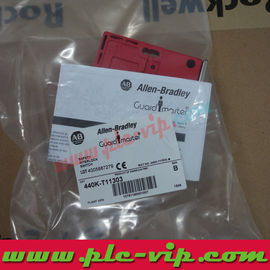
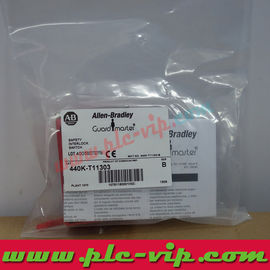
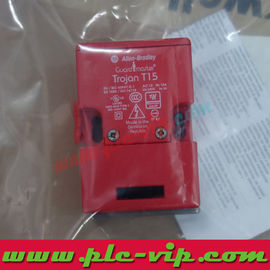
440G-T27249
This page documents catalog number 440G-T27249, which belongs to the 440G TLS-GD2 guard locking family. The point worth stating first is what the published selection matrix does not cover: this number is not printed in the matrix rows that assign type, solenoid voltage, entry and actuator, so those four attributes are not claimed here. The shared family figures below are established and quoted; the combination is to be read from the nameplate and the Rockwell catalog before the order is confirmed.
A catalog number that the selection matrix does not print is not a number without content. The mechanism, the contact set, the holding force and the environmental limits are family properties. What the matrix would have told a buyer, and what this page therefore leaves open, is the combination: which type, which coil, which entry and whether an actuator ships with it.
Shared family data for every TLS-GD2 number
| Field | Value |
| Standards | ISO 14119, IEC 60947-5-1, plus EN 1088, NFPA 79 and ANSI B11.19 in the family sheet |
| Safety classification | Type 2 interlocking device with guard locking and low coding (tongue) per ISO 14119 |
| Holding force Fmax | 1,950 N (488 lbf) with plastic pins, 2,600 N (585 lbf) with steel bolts |
| Holding force Fzh | 1,500 N (337 lbf) with plastic pins, 2,000 N (450 lbf) with steel bolts |
| Releasable load | 100 N (22.5 lbf) maximum |
| Solenoid power | 7 W typical at 100 percent duty |
| Escape release button | 50 N (11.25 lbf) maximum, escape release versions only |
| Thermal current | 10 A; rated insulation voltage 500 V |
| Switching | A600 AC-15 at 600 V and 1.2 A, DC-13 at 24 V and 2 A, minimum 5 mA at 5 V dc |
| Actuation | 160 mm/s maximum, 100 mm/min minimum, 1 cycle per second |
| Operating radius | 160 mm minimum, 80 mm with the flexible actuator 440G-A27143 |
| Mechanical life | 1,000,000 operations at 100 mA load |
| Enclosure | IP66, IP67 and IP69K, with IP rated glands or cordset required for IP69K |
| Temperature | minus 20 to plus 60 C |
| Weight | 400 g (0.88 lb), red glass-filled PBT housing, stainless steel actuator |
Reading the number that is not in the matrix
Reading the four marks. The switch type is printed on the nameplate next to the catalog number. The coil voltage is marked on the solenoid body and can be read without removing the lid. The entry is visible from outside: an M20 thread, a 1/2 inch NPT adaptor, a 12-pin M23 receptacle or an 8-pin micro receptacle. The actuator, where one is fitted, is identifiable by its shape against the published actuator list. Four marks, one order.
Why the family figures still apply. The holding force, contact ratings, solenoid power, actuation limits, ingress rating and maintenance intervals are properties of the TLS-GD2 mechanism rather than of any one catalog number, so they hold for every number in the range including this one. What changes with the number is the contact configuration of the chosen type, the coil voltage, the entry and whether an actuator ships in the box.
What to confirm before ordering. Confirm the coil voltage against the control circuit, because a 230 V ac coil on a 24 V dc safety circuit is a commissioning fault rather than a wiring error. Confirm the entry against the gland or cordset already specified, since an M23 receptacle and an M20 entry do not share cables. Confirm whether the guard needs full body access, because the escape release exists only in the T21B series and cannot be added to a T27 number afterwards.
Nearest numbers in the range that the matrix does place are 440G-T27247, 440G-T27246, 440G-T27251, each documented on its own page, so the attribute pattern of this number can be checked against them before an order is placed.
Mounting torque. The installation data gives three torques that matter: 1.4 N m for the mounting bolts, 1.2 N m for the lid screws and 1.02 N m for the terminal screws. Over-torquing the lid distorts a glass-filled PBT housing that is also the IP69K barrier, and under-torquing the terminals is the failure that shows up months later as an intermittent safety circuit rather than as a wiring fault.
The rest of the TLS-GD2 range is documented page by page on this site, including the numbers whose type, solenoid, entry and actuator the matrix does state. Where a buyer needs certainty on this one, the honest answer is a nameplate photograph rather than a guess, and that is what this page asks for.
Environment, mounting and maintenance of the TLS-GD2 switch
| Parameter | Value |
| Catalog number | 440G-T27249 |
| Enclosure type rating | IP66, IP67, IP69K; IP69K requires appropriate IP-rated glands or cordset |
| Operating temperature | -20...+60 °C (-4...+140 °F) |
| Housing and actuator material | Housing UL-approved glass-filled PBT; actuator stainless steel |
| Weight | 400 g (0.88 lb) |
| Body length and hole spacing | 126 mm (4.96 in.) overall, 105 mm (4.13 in.) between mounting holes |
| Mounting bolts, max torque | 1.4 N·m (12.39 lb·in) |
| Lid screws, max torque | 1.2 N·m (10.62 lb·in) |
| Terminal screws, max torque | 1.02 N·m (9 lb·in) |
| Break contact force, min | 30 N (7 lbf) |
| Actuation speed | 100 mm (3.94 in.) per minute minimum, 160 mm (6.29 in.)/s maximum |
| Actuation frequency, max | 1 cycle/s |
| Operating radius, min | 160 mm (6.3 in.), 80 mm (3.15 in.) with the flexible actuator 440G-A27143 |
| Mechanical life | 1,000,000 operations |
Mounting rules come from 440G-IN022 and they are mechanical rather than electrical. The switch is not a mechanical stop, so guard stops and guides have to be fitted and the impact of a closing guard must not reach the head or the actuator. The mounting surface must be metal with a low-impedance connection to the machine earthing system, and the bolts that hold the body are therefore part of that path. Tightening figures are 1.4 N·m for the mounting bolts, 1.2 N·m for the lid screws and 1.02 N·m for the terminal screws, and over-torque on a glass-filled PBT housing distorts the body enough to shift the four-entry head out of alignment. For 440G-T27249 the figures above apply as printed.
Two maintenance intervals are printed, and both are part of the warranty terms. Weekly: operate and check the switching circuit, look for abuse or tampering, inspect the casing for damage and replace a damaged unit. At least every six months: isolate all power, remove the lid, check every terminal for tightness, clean out accumulated fine dirt, inspect the actuator, the cam assembly and the contacts for wear or oxidation, refit the covers at the specified torques, reinstate the power, check operation and reapply tamper-evident varnish to the screws. Repair is not offered in that document; a malfunctioning or damaged switch is replaced before the machine may run again. For 440G-T27249 the figures above apply as printed.
IP69K is a claim about the gland as much as about the housing. 440G-IN022 annotates the rating with the condition that appropriate IP-rated glands or a suitable cordset are used, so a switch wired through an ordinary cable entry should be read as an IP66/IP67 device in service. The sealed housing needs no cabinet of its own; a washdown or corrosive atmosphere can still justify one, but that is a plant decision rather than a product limitation. On 440G-T27249 the gland fitted at installation is what decides whether the claim holds.
The figures above are family values from 440G-IN022. For 440G-T27249 the attributes that do change with the catalog number are the contact set, the solenoid voltage and the entry and actuator combination, and those are stated in the tables earlier on this page.
No performance level for a machine, no guard cycle count and no price is stated. The family figures are quoted from the TLS-GD2 installation instructions; the four attributes that vary by catalog number are left open on this page because the published matrix does not carry this number.
ArmorPoint modules are installed by bridging two bases, which is why every mechanical figure in this family is stated with the base included rather than for the module alone. The catalog number covered on this page is 440G-T27249.