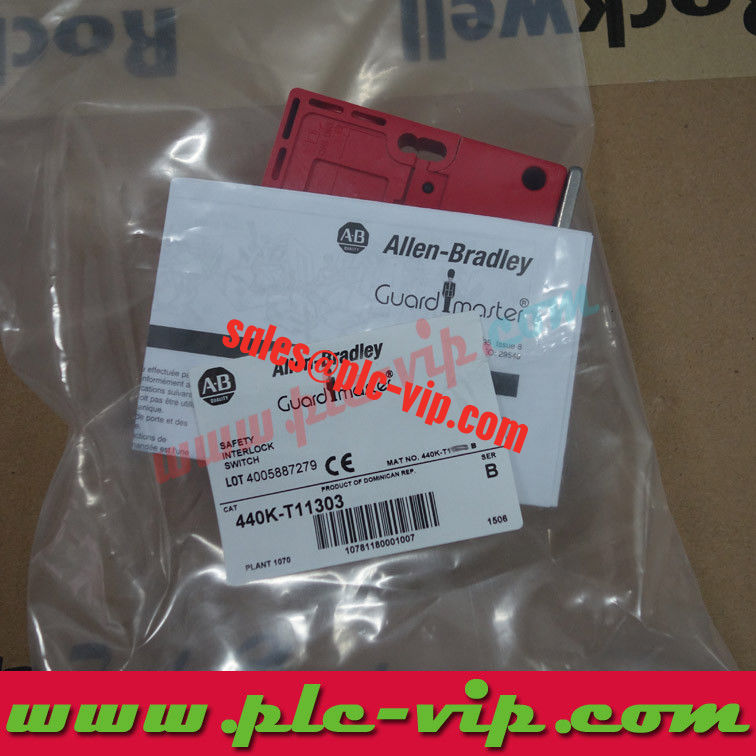
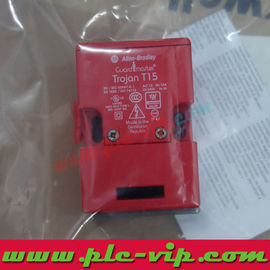
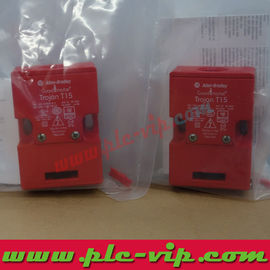
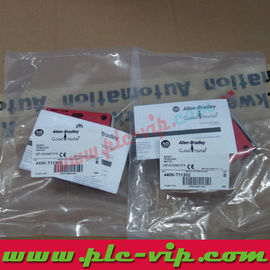
440G-T27235
This page documents catalog number 440G-T27235, a TLS-GD2 positive-mode tongue-operated guard locking switch. The TLS-1 variant locks a machine guard closed until power is isolated and keeps the isolation in place while the guard is open. This number is power to release with position monitoring 2 N.C. and 1 N.O. plus lock monitoring 1 N.C. and 1 N.O., a 24 V ac/dc solenoid supply, 12-pin M23 connector, and fully flexible actuator 440G-A27143 fitted. The figures below are quoted from the TLS-GD2 installation instructions and from the published selection matrix, not inferred.
What the switch is and what it carries
| Field | Value |
| Standards | ISO 14119, IEC 60947-5-1, plus EN 1088, NFPA 79 and ANSI B11.19 in the family sheet |
| Safety classification | Type 2 interlocking device with guard locking and low coding (tongue) per ISO 14119 |
| Holding force Fmax | 1,950 N (488 lbf) with plastic pins, 2,600 N (585 lbf) with steel bolts |
| Holding force Fzh | 1,500 N (337 lbf) with plastic pins, 2,000 N (450 lbf) with steel bolts |
| Releasable load | 100 N (22.5 lbf) maximum |
| Solenoid power | 7 W typical at 100 percent duty |
| Escape release button | 50 N (11.25 lbf) maximum, escape release versions only |
| Thermal current | 10 A; rated insulation voltage 500 V |
| Switching | A600 AC-15 at 600 V and 1.2 A, DC-13 at 24 V and 2 A, minimum 5 mA at 5 V dc |
| Actuation | 160 mm/s maximum, 100 mm/min minimum, 1 cycle per second |
| Operating radius | 160 mm minimum, 80 mm with the flexible actuator 440G-A27143 |
| Mechanical life | 1,000,000 operations at 100 mA load |
| Enclosure | IP66, IP67 and IP69K, with IP rated glands or cordset required for IP69K |
| Temperature | minus 20 to plus 60 C |
| Weight | 400 g (0.88 lb), red glass-filled PBT housing, stainless steel actuator |
What this catalog number selects
| Attribute | Value |
| Type | TLS-1 |
| Locking principle | power to release |
| Safety contacts | 3 N.C. direct opening action |
| Auxiliary contacts | 2 N.O., one of them used for solenoid monitoring |
| Solenoid supply | 24 V ac/dc |
| Actuator | fully flexible actuator 440G-A27143 fitted |
| Entry | 12-pin M23 connector |
Where this number sits in the range
The other numbers in the same TLS-1 24 V ac/dc group are 440G-T27235 (12-pin M23 connector, fully flexible actuator 440G-A27143 fitted), 440G-T27252 (M20 conduit entry, fully flexible actuator 440G-A27143 fitted). At the same coil, entry and actuator the power to lock version is 440G-T27241.
Why this combination exists
Functional safety. The family data gives B10d above 2 million operations at minimum load, PFHD below 3 x 10^-7 and MTTFd above 385 years, on a stated usage rate of 10 operations per 10 minutes, 24 hours a day, 360 days a year, with a mission time of 38 years. PLe or PLd and SIL 2 or SIL 3 are described as possible depending on architecture, so the switch is a component of a performance level rather than a promise of one.
Power to release logic. Power to release means the guard is locked whenever the solenoid is unpowered, and the guard opens only when a signal reaches the solenoid. The published note is that this signal can come from CU1 electronic timer relays or CU2 stopped motion detectors, which is the reason the type exists: machines that do not stop immediately need the guard to stay locked until motion is actually gone. The catalog number covered on this page is 440G-T27235.
Actuation geometry. The published actuation speeds bracket the mechanism at both ends: 160 mm/s maximum and 100 mm/min minimum. A guard that closes slower than the minimum does not actuate reliably, which is why a heavy hinged door on a gas strut needs its closing time measured rather than assumed. The minimum operating radius is 160 mm, or 80 mm with the flexible actuator.
The rear escape release is not part of 440G-T27235. That option is published as a separate series, the T21B numbers, where the letter P in the catalog number denotes power to release with escape release. A guard with full body access needs that series, and the distinction is worth checking before a purchase order is raised on a T27 number.
Environment, mounting and maintenance of the TLS-GD2 switch
| Parameter | Value |
| Catalog number | 440G-T27235 |
| Enclosure type rating | IP66, IP67, IP69K; IP69K requires appropriate IP-rated glands or cordset |
| Operating temperature | -20...+60 °C (-4...+140 °F) |
| Housing and actuator material | Housing UL-approved glass-filled PBT; actuator stainless steel |
| Weight | 400 g (0.88 lb) |
| Body length and hole spacing | 126 mm (4.96 in.) overall, 105 mm (4.13 in.) between mounting holes |
| Mounting bolts, max torque | 1.4 N·m (12.39 lb·in) |
| Lid screws, max torque | 1.2 N·m (10.62 lb·in) |
| Terminal screws, max torque | 1.02 N·m (9 lb·in) |
| Break contact force, min | 30 N (7 lbf) |
| Actuation speed | 100 mm (3.94 in.) per minute minimum, 160 mm (6.29 in.)/s maximum |
| Actuation frequency, max | 1 cycle/s |
| Operating radius, min | 160 mm (6.3 in.), 80 mm (3.15 in.) with the flexible actuator 440G-A27143 |
| Mechanical life | 1,000,000 operations |
The unit is not a mechanical stop. Publication 440G-IN022 requires guard stops and guides to be fitted, so the weight of the guard and the impact of closing it are carried by the door hardware and never by the actuator or the head. The switch also has to sit on a metal surface that provides a low-impedance connection to the machine earthing system, which makes the mounting bolts part of the earth path rather than a convenience. The maxima are 1.4 N·m for the mounting bolts, 1.2 N·m for the lid screws and 1.02 N·m for the terminal screws; a screw driven past its figure distorts the glass-filled PBT housing and moves the head alignment the actuator depends on. For 440G-T27235 the figures above apply as printed.
Maintenance is prescribed at two frequencies. Weekly, the switching circuit is operated and checked, the casing is inspected for signs of abuse or tampering, and a damaged unit is replaced rather than repaired. At least every six months the power is isolated, the lid removed, every terminal checked for tightness, fine dirt cleaned out, the actuator, cam assembly and contacts inspected for wear or oxidation, the covers refitted at the specified torques, the power reinstated, operation rechecked and the tamper-evident varnish reapplied to the screws. The same publication states that any malfunction or damage means the switch is replaced before the machine is allowed to run. For 440G-T27235 the figures above apply as printed.
IP69K is a claim about the gland as much as about the housing. 440G-IN022 annotates the rating with the condition that appropriate IP-rated glands or a suitable cordset are used, so a switch wired through an ordinary cable entry should be read as an IP66/IP67 device in service. The sealed housing needs no cabinet of its own; a washdown or corrosive atmosphere can still justify one, but that is a plant decision rather than a product limitation. On 440G-T27235 the gland fitted at installation is what decides whether the claim holds.
The figures above are family values from 440G-IN022. For 440G-T27235 the attributes that do change with the catalog number are the contact set, the solenoid voltage and the entry and actuator combination, and those are stated in the tables earlier on this page.
The page states no performance level for a machine, no guard cycle count and no cable length beyond the published cordsets, because those follow from the application and not from the catalog number. Where a figure is missing here it is missing from the source publication for 440G-T27235 as well.
No service life claim and no price is implied. Contacts, solenoid and environmental limits are quoted from the TLS-GD2 installation instructions, and the type, solenoid, entry and actuator assignment is quoted from the published selection matrix row that carries this catalog number. The catalog number covered on this page is 440G-T27235.