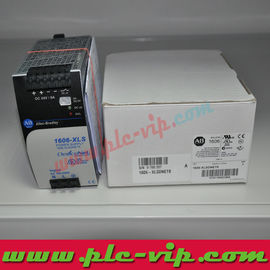
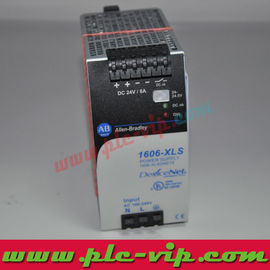
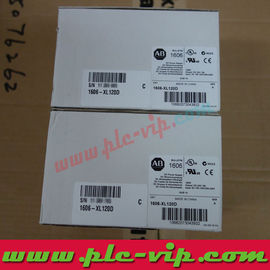
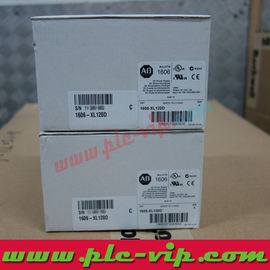
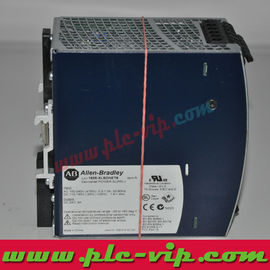
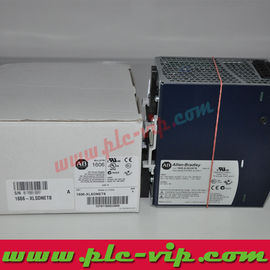
1606-XL240E-3
This page documents the 1606-XL240E-3, a member of the Bulletin 1606 switched-mode power supply range: 24...28 V output at no output current printed, 240 W, with an unprinted input window. The selection and specification figures below are quoted from Rockwell publication 1606-TD002, which prints them per catalog number or per model row.
Selection row for this catalog number
| Attribute | Published value |
| Catalog number | 1606-XL240E-3 |
| Product family | Bulletin 1606 switched-mode power supply |
| Output voltage, nominal | 24...28 V |
| Output current, nominal | no output current printed |
| Output power | 240 W |
| Input, AC | not printed for this string |
| Input, DC | not printed for this string |
| Feature or limitation flag | legacy 1606-XL unit |
| Lifecycle status | Discontinued |
| Status date | October 30, 2017 |
| Replacement category | Direct Replacement |
| Replacement catalog number | 1606-XLE240E-3 |
How this string is built
| Position | Value | Meaning |
| Prefix | 1606 | Bulletin number for switched-mode power supplies |
| Series letters | XL | the original XL line |
| Digits | 240 | rated output power in watts |
| Voltage letter | E | 24...28 V |
| Trailing suffix | -3 | three-phase input |
The rule to carry into a bill of materials check is that the digits are watts and the letter after them is the output voltage, so two strings that differ only in the trailing characters share the power stage and differ in input window, terminal style or coating. A substitution across those characters is a mechanical or environmental decision rather than an electrical one, and the replacement category in the row above tells which kind of re-validation it needs.
Where this model sits in the XL line
| Series attribute | Published value |
| Series | 1606-XL Power Supply (legacy line) |
| Power range | 60...960 W |
| Overload / boost | not published for this line in the current technical data |
| Reserve current | not published for this line in the current technical data |
| Efficiency, typical | not published for this line in the current technical data |
| Operating temperature | not published for this line in the current technical data |
| Terminals | screw terminals |
| Mains versions | single-phase 100...240 V AC and three-phase 380...480 V AC versions |
The line exists for the reason printed against it: the first generation of Bulletin 1606 that the XLE and XLS lines replaced part by part. Against this string that means the no output current printed output is one point inside a 60...960 W range, and the reserve and boost figures belong to the whole line, so a load sized on the continuous rating plus the published reserve is a load the line is designed to carry rather than one it tolerates.
Lifecycle reading and what a substitute inherits
Rockwell lists this number as discontinued, with a status date of October 30, 2017 and a replacement category of direct replacement, pointing at 1606-XLE240E-3. The electrical figures on this page stay valid for the number itself; what the replacement category tells a panel builder is how much of the surrounding work carries over - a direct replacement is a swap in the same space with the same wiring, an engineering replacement moves terminals or footprint, and no planned replacement means the panel itself has to be re-thought.
A discontinued string is still orderable only while distributor stock lasts, so the substitution decision belongs in the bill of materials while the machine is being specified rather than during a shutdown. The published electrical figures do not change on a discontinued number; the sourcing route does.
Load, heat and input protection
Three calculations follow from the row above. The output load is the sum of everything on the rail against no output current printed, with the published reserve as the allowance for inrush rather than as continuous capacity. The heat inside the enclosure is the output power divided by the efficiency figure for this frame, and it is what a sealed cabinet has to dissipate. The input protection is sized from the input current at the lowest voltage of the published window, not at nominal mains, because that is where the current is highest.
A supply is a branch-circuit load with its own protection and its own inrush. On 1606-XL240E-3, choosing the breaker on the nominal input current is the mistake that shows up as a nuisance trip on a cold morning, when the input voltage is low and the bulk capacitors are empty.
Other strings in the same series
Neighbouring numbers to 1606-XL240E-3 in the XL series are 1606-XLB120E, 1606-XLB240E, 1606-XLB36EH. They differ in rated watts, output voltage or input frame rather than in construction, so the selection between them is made on load and on the mains available at the panel.
Terminals decide the wiring time more than the rating does. Spring terminals, screw terminals, push-in terminals and plug connectors all appear on this bulletin at the same power class. The terminal style is chosen by how the panel is wired and by whether the unit is expected to be swapped on site, and it is part of the catalog string rather than a build option added later.
Lifecycle status changes the spare, not the specification. A discontinued string keeps its published electrical figures; what changes is the path Rockwell prints for it: direct replacement, engineering replacement with different mounting or wiring, or no planned replacement. The replacement category is the amount of re-validation work a panel inherits, and it is the reason a bill of materials is read with the lifecycle column next to the rating.
Efficiency is a thermal number before it is an energy number. A 90 to 95 percent efficiency figure on a 480 W supply leaves 25 to 48 W of heat inside the enclosure, which is the difference between a sealed cabinet that holds temperature and one that needs forced ventilation. The efficiency band is published per series rather than per model, so the number to check is the one for the frame size that was ordered.
The feature flag on this row reads: legacy 1606-XL unit. That flag is the field that separates this number from its neighbours of the same wattage and voltage, and it is the one to read first in a substitution, because a supply that differs only in its flag differs in mounting, terminals or output limitation rather than in power.
Checks before substituting another 1606 number
A substitution audit for this number runs in a fixed order: output voltage, then continuous current against the load schedule, then the input frame actually present at the site, then the terminal style, and last the lifecycle category. Any one of the five can invalidate a part that looks correct in a catalogue row, and the cheapest place to catch it is the bill of materials rather than the parts counter during a shutdown.
Read this row against the panel it will feed rather than against the catalogue page: the output is what the rail needs, the reserve is what the inrush may borrow, the efficiency is what the cabinet must dissipate, and the input window is what the site must supply. A number that satisfies the first three and fails the fourth is a unit that is correct on paper and unusable on a low-line branch.
Questions this catalog number answers
What is 1606-XL240E-3? 1606-XL240E-3 is a switched-mode power supply in the Bulletin 1606 range: 24...28 V output at no output current printed, 240 W, with an input window printed in the selection table.
Is 1606-XL240E-3 current? Rockwell prints the status as discontinued with a status date of October 30, 2017, and the replacement category as direct replacement pointing at 1606-XLE240E-3.
What decides the input protection for 1606-XL240E-3? The input current at the lowest voltage of the printed window, not the nominal mains figure, because that is where the branch current peaks and where a breaker chosen on nominal current trips on a cold start.
No price and no lead time is implied on this page. For 1606-XL240E-3 the selection, series and lifecycle figures are quoted from Rockwell publication 1606-TD002 and the published catalog number explanation; a field the publication does not print for this string is marked as such rather than estimated from a neighbouring model.