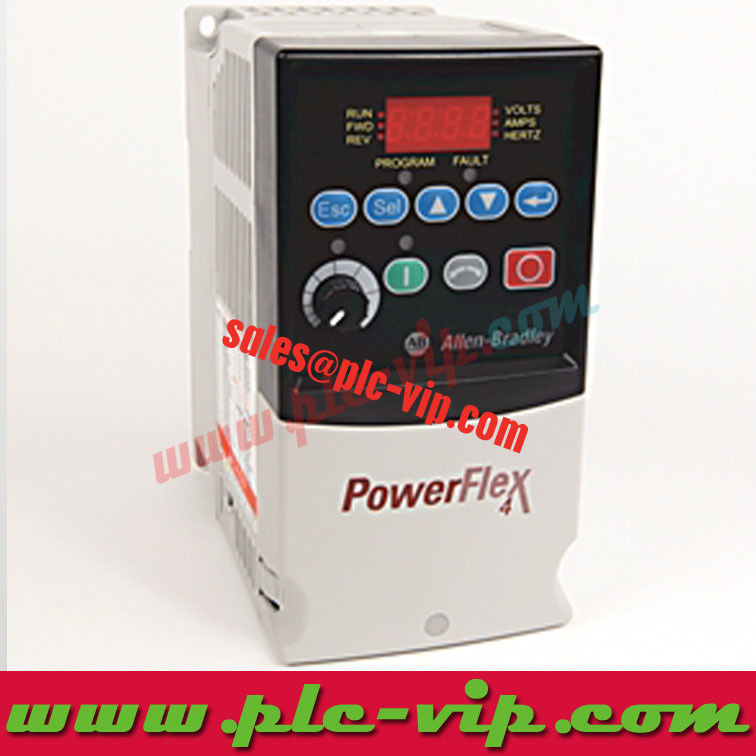
20BW142A0ANNANC0
This page documents catalog number 20BW142A0ANNANC0, a PowerFlex 700 drive in the 932 V DC input class. The decode and the class definitions come from the drive family's published catalog number explanation and voltage table; the option region is interpreted only where the family publishes a rule for it.
Decode and published values
| Specification | Value |
|---|
| Catalog number | 20BW142A0ANNANC0 |
| Family (first three characters) | 20B - PowerFlex 700 |
| Input class | W - 932 V DC, precharge Y |
| Rating code | 142 - 142 A |
| Enclosure field | A - IP20, NEMA/UL Type 1 |
| Brake field as ordered | N - no brake IGBT |
| Brake field | Y fitted / N not fitted; standard on frames 0-3, optional on frames 4-6 |
| Highest DC class on this platform | 932 V DC, once above 810 V DC |
| AC class at the same bus level | 690 V AC three-phase, by the 1.35 arithmetic labelled on this page |
| Published rating block for this class | ND and HD horsepower and kW per frame, in the DC input block, 932 V column |
| Not quoted on this page | kW and frame pairing for this string, because only the 932 V column can supply it |
What the string settles and what the system has to settle
This is the 142 A entry of the 932 V DC class, and it is the largest current in the family's highest DC voltage class on this platform. The string reads 20B for PowerFlex 700, W for 932 V DC, 142 for the output current, A for the enclosure field and N in the brake field.
The combination of the highest voltage class and a mid-range current makes this a common-bus section for a 690 V installation. The AC correspondence is arithmetic and it is labelled as such: 1.35 times 690 V is about 931 V, so the 932 V DC class is the direct-current counterpart of the 690 V AC class, and a project described in one vocabulary can be read in the other.
Precharge Y belongs to the class. The published voltage table lists W with precharge, along with N, P, R and T, while H and J at 540 and 650 V DC are published without it. That means this drive can charge its own DC link in a controlled way, and the panel's job is the energisation sequence and the coordination rather than the inrush limiter.
The rating code reads as 142, which is 142 amps under the family's three-character convention. The number is close to the 142 A code in the 690 V AC class, and that coincidence is a trap: the two strings differ in the voltage letter and describe different inputs, one alternating and one direct. A parts system that matches on the code alone will confuse them.
Where the published DC block gives horsepower and kW per frame for each of the five DC voltages, this page does not quote a kW for this string. The 932 V column is the only source for that pairing, and the 690 V AC table is a different table for a different input, so a kW value cannot be carried across from it even though the current code is the same number.
The brake field reads N, which the family's rule makes definite: no brake IGBT, and the option is available on frames 4 to 6. On a 142 A section the returned energy is significant, so a brake-less string implies a bus that absorbs it or a process that does not regenerate hard. That is a system statement, not a defect.
Enclosure A is IP20 and NEMA/UL Type 1, with F and G covering open and flange mounting and stand-alone wall mounting. On a 932 V DC installation the cabinet's creepage and clearance distances are the design item, because the bus voltage is above what a 690 V AC panel's wiring practice assumes at the bus, and the enclosure code alone does not settle that.
The terminal documentation carries real weight at this voltage: the larger frames publish input power, DC+, DC-, BR1, BR2, PE and the motor connections as one group with wire ranges and torque values per frame, and a bus joint that is under-torqued at 932 V DC is a hot spot with a long service life ahead of it before it announces itself.
The documentation also publishes input protection device tables for the DC classes, organised by frame, and a section at this level of the highest class has to satisfy the coordination of the whole installation rather than the table of a single drive.
The remaining option characters are not decoded here, and the honest statement about an unresolved tail is that it is unresolved. The identification of the string is what this page can give; the confirmation of its options belongs to the supplier.
No lifecycle statement and no price is implied. Class and precharge definitions, the brake rule, the rating-code convention, the enclosure field and the terminal grouping are quoted from the drive family's published documentation; the bus arithmetic is labelled as arithmetic.
The other drives, reactors and drive spares in this range are collected in the Drives & Motors category. Codes documented alongside this one are 20BW052A0ANNANC0, 20BW098A0ANNANC0, 20BW098A0AYNANC0, 20BF119A0ANNANC0, and this drive is listed at 20BW142A0ANNANC0.
The twelve 20B voltage codes, and the frames each one is built on
The fourth character of a 20B catalog number is the voltage code, and there are twelve of them: five AC classes and seven DC-bus classes. They are not interchangeable, they do not share frame ranges, and the DC codes additionally split on whether a pre-charge circuit is built in. This table is the complete code list from the 20B-TD001 catalog explanation, with the frame range each class is built on.
| Code | Voltage rating | Frames built on | Where the class is used |
| B | 240 V AC, 3-phase, 50/60 Hz | 0-6 | 208...240 V supply, the North American low-voltage class |
| C | 400 V AC, 3-phase, 50/60 Hz | 0-6 | 380...415 V supply, the European standard class |
| D | 480 V AC, 3-phase, 50/60 Hz | 0-6 | 440...480 V supply, the widest rating ladder of the series |
| E | 600 V AC, 3-phase, 50/60 Hz | 0-6 | 575...600 V supply, Canada and heavy industry |
| F | 690 V AC, 3-phase, 50/60 Hz | 5-6 | 690 V supply, and only on the larger frames |
| H | 540 V DC input, pre-charge | 5-6 | fed from a 540 V DC bus, pre-charge circuit built in |
| J | 650 V DC input | 5-6 | 650 V DC common DC bus, no pre-charge letter |
| N | 325 V DC input (Y), pre-charge | 5-6 | 325 V DC bus, common-bus configuration |
| P | 540 V DC input (Y), pre-charge | 5-8 | 540 V DC common bus, the widest DC frame range |
| R | 650 V DC input (Y), pre-charge | 5-8 | 650 V DC common bus, frames 5 through 8 |
| T | 810 V DC input (Y), pre-charge | 5-6 | 810 V DC bus for 600 V class front ends |
| W | 932 V DC input (Y), pre-charge | 5-6 | 932 V DC bus for 690 V class front ends |
Where this page sits: 20BW142A0ANNANC0 decodes to voltage code W, which 20B-TD001 defines as 932 V DC input (Y), pre-charge, built on frames 5-6. The rating field reads 142 A.
What is missing here is the ladder itself: the rating tables that turn these codes into amp, power and frame steps are printed per voltage class in 20B-TD001, and only the 240, 400 and 480 V classes were transcribed for this site. For 600 V, 690 V and the DC-bus classes the neighbouring current steps are therefore not listed, and none is inferred from another class.
Catalog prefix first: 20B is the PowerFlex 700 prefix and 20A is the PowerFlex 70 prefix. A page filed under a "PowerFlex 70 drives" group while carrying a 20B number is a filing error at the prefix level - the two are different product lines with different frame ranges, not variants of one another. The catalog number on the page decides, not the group label.
Source: 20B-TD001 PowerFlex 700 catalog number explanation (voltage, rating and frame codes) and the 20B-TD001 rating tables. Values are quoted as printed; no figure on this page is calculated or extrapolated.