20BR535U0ANNNND1
This page documents catalog number 20BR535U0ANNNND1, a PowerFlex 700 drive in the 650 V DC input class. The class and option definitions come from the drive family's published catalog number explanation; where the string carries a character the published option set does not cover, this page says so instead of assigning a meaning.
Decode and published values
| Specification | Value |
|---|
| Catalog number | 20BR535U0ANNNND1 |
| Family | 20B - PowerFlex 700 |
| Input class | R - 650 V DC, precharge Y |
| Rating code | 535 - 535 A |
| Enclosure-position character | U - outside the documented enclosure set A, F, G so not read as an enclosure code |
| Brake field | N - no brake IGBT |
| Final option characters | NNNND1, not decoded on this page |
| Relation to the 365 A string | Same class and same pattern, differing in the rating code and the last character |
| AC class at the same bus level | 480 V AC three-phase, by the 1.35 arithmetic labelled on this page |
What the string settles and what the system has to settle
This page documents the 535 A entry of the 650 V DC class on this platform, the largest of the three R-class strings listed here, and it repeats a pattern that the published option set does not fully describe. The string reads 20B for PowerFlex 700, R for the 650 V DC class, 535 for the output current, U in the enclosure position, and then 0 followed by a run of N characters ending in D1.
The documented enclosure codes for this family are A for IP20 and NEMA/UL Type 1, F for open and flange mounting and G for stand-alone and wall mounting. U is not one of them, so this page does not treat it as an enclosure field. The consequence is practical rather than academic: an enquiry for this string should quote it whole and ask the supplier to confirm the configuration, because a buyer who assumes U means one of the three documented enclosures is assuming a fact that the documentation does not support.
The class letter, by contrast, is fully documented. R is 650 V DC with precharge Y, and the family also publishes J at the same voltage without precharge, so the two letters describe drives that a voltage-and-current reading would call identical and that differ in whether they can limit their own inrush.
At 535 A the drive is a bus section rather than a device, and the numbers that matter are the ones the panel designer owns: the bus capacitance of the whole installation, the charging arrangement, the fault coordination and the thermal design of the enclosure. The drive contributes its current rating, its class and its precharge path, and nothing else in the catalog string settles those four.
The AC equivalent of the class is arithmetic and it is stated as arithmetic here: three-phase rectification produces a bus of roughly 1.35 times the line voltage, so 480 V gives about 648 V and the 650 V DC class corresponds to the 480 V AC class. That is the sentence that lets an existing 480 V-fed installation be compared with a common-bus replacement on the same terms.
The brake field reads N and the family's published rule makes that a definite statement: N means no brake IGBT, and the option is available on frames 4 to 6. A drive of this size without a brake passes regenerative energy back to the bus, which is a deliberate arrangement on a common-bus system and a problem on an isolated one.
The rating code reads as 535 A output under the family's convention of three characters for normal-duty amps. The reading is independent of the class letter, which is why the letter has to be read separately rather than inferred from the number.
What the page deliberately avoids is pairing this current with a kW and a frame taken from another voltage class. The published DC block gives horsepower and kW per frame for each of the five DC voltages, and only the 650 V column of that block can supply a defensible pairing for this string.
The terminal and protection documentation still applies. The family publishes wire ranges and torques per frame, lists the DC terminals together with input power and the motor connections on the larger frames, and publishes separate protection device tables for the 540 V DC and 650 V DC inputs. On a 535 A section those two tables are the differences between a serviced installation and an incident.
The closing characters are not decoded, and the honest statement is that they are not decoded rather than that they are irrelevant. The string is the identification; the interpretation of its tail is the supplier's confirmation, not this page's inference.
No lifecycle statement and no price is implied, and no availability claim is made for a string whose option pattern the published explanation does not resolve.
The other drives, reactors and drive spares in this range are collected in the Drives & Motors category. Codes documented alongside this one are 20BR156A0AYNANC0, 20BR365U0ANNNND0, 20BF142A0ANNANC0, and this drive is listed at 20BR535U0ANNNND1.
The twelve 20B voltage codes, and the frames each one is built on
The fourth character of a 20B catalog number is the voltage code, and there are twelve of them: five AC classes and seven DC-bus classes. They are not interchangeable, they do not share frame ranges, and the DC codes additionally split on whether a pre-charge circuit is built in. This table is the complete code list from the 20B-TD001 catalog explanation, with the frame range each class is built on.
| Code | Voltage rating | Frames built on | Where the class is used |
| B | 240 V AC, 3-phase, 50/60 Hz | 0-6 | 208...240 V supply, the North American low-voltage class |
| C | 400 V AC, 3-phase, 50/60 Hz | 0-6 | 380...415 V supply, the European standard class |
| D | 480 V AC, 3-phase, 50/60 Hz | 0-6 | 440...480 V supply, the widest rating ladder of the series |
| E | 600 V AC, 3-phase, 50/60 Hz | 0-6 | 575...600 V supply, Canada and heavy industry |
| F | 690 V AC, 3-phase, 50/60 Hz | 5-6 | 690 V supply, and only on the larger frames |
| H | 540 V DC input, pre-charge | 5-6 | fed from a 540 V DC bus, pre-charge circuit built in |
| J | 650 V DC input | 5-6 | 650 V DC common DC bus, no pre-charge letter |
| N | 325 V DC input (Y), pre-charge | 5-6 | 325 V DC bus, common-bus configuration |
| P | 540 V DC input (Y), pre-charge | 5-8 | 540 V DC common bus, the widest DC frame range |
| R | 650 V DC input (Y), pre-charge | 5-8 | 650 V DC common bus, frames 5 through 8 |
| T | 810 V DC input (Y), pre-charge | 5-6 | 810 V DC bus for 600 V class front ends |
| W | 932 V DC input (Y), pre-charge | 5-6 | 932 V DC bus for 690 V class front ends |
Where this page sits: 20BR535U0ANNNND1 decodes to voltage code R, which 20B-TD001 defines as 650 V DC input (Y), pre-charge, built on frames 5-8. The rating field reads 535 A.
What is missing here is the ladder itself: the rating tables that turn these codes into amp, power and frame steps are printed per voltage class in 20B-TD001, and only the 240, 400 and 480 V classes were transcribed for this site. For 600 V, 690 V and the DC-bus classes the neighbouring current steps are therefore not listed, and none is inferred from another class.
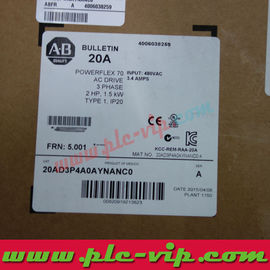
Catalog prefix first: 20B is the PowerFlex 700 prefix and 20A is the PowerFlex 70 prefix. A page filed under a "PowerFlex 70 drives" group while carrying a 20B number is a filing error at the prefix level - the two are different product lines with different frame ranges, not variants of one another. The catalog number on the page decides, not the group label.
Source: 20B-TD001 PowerFlex 700 catalog number explanation (voltage, rating and frame codes) and the 20B-TD001 rating tables. Values are quoted as printed; no figure on this page is calculated or extrapolated.