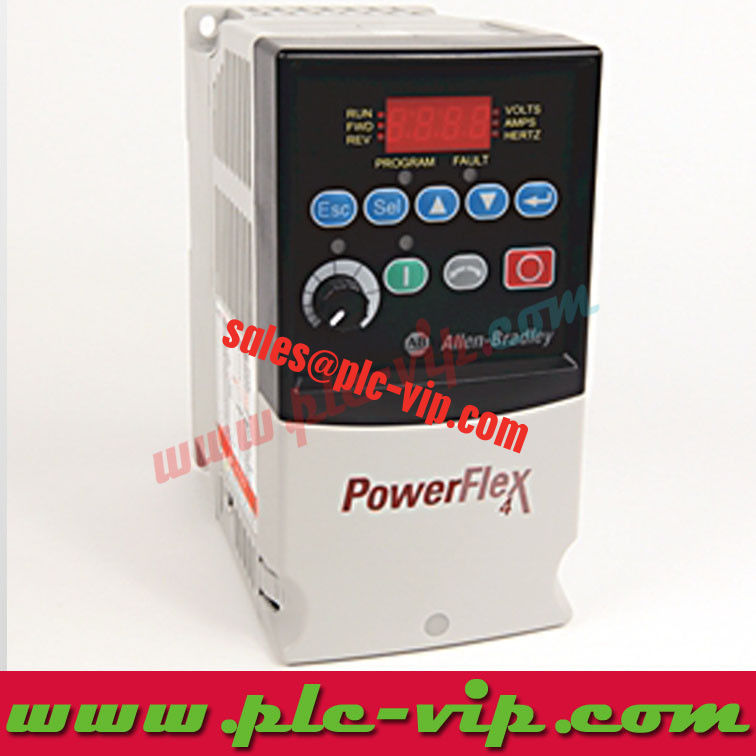
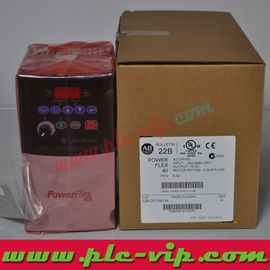
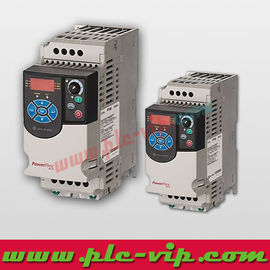
20BR156A0AYNANC0
This page documents catalog number 20BR156A0AYNANC0, a PowerFlex 700 drive in the 650 V DC input class. The class and option definitions come from the drive family's published catalog number explanation; where the string carries a character the published option set does not cover, this page says so instead of assigning a meaning.
Decode and published values
| Specification | Value |
|---|
| Catalog number | 20BR156A0AYNANC0 |
| Family | 20B - PowerFlex 700 |
| Input class | R - 650 V DC, precharge Y |
| Rating code | 156 - 156 A |
| Enclosure field | A - IP20, NEMA/UL Type 1 |
| Brake field | Y - brake IGBT fitted |
| Brake rule | Standard on frames 0-3, optional on frames 4-6 |
| Other listing of the same rating | 20BR156A0ANNANC0 - identical except the brake field reads N |
| AC class at the same bus level | 480 V AC three-phase, by the 1.35 arithmetic labelled on this page |
What the string settles and what the system has to settle
This string and the other listing of the same rating differ in one character, and that character is the only one in the string whose meaning the family publishes as a plain yes or no. Both read 20B for PowerFlex 700, R for the 650 V DC class, 156 for the output current, and A for the enclosure; this one carries Y where the other carries N.
The published option table maps that position to the brake IGBT: Y means the brake is fitted, N means it is not, and the same table states that the brake is standard on frames 0 to 3 and optional on frames 4 to 6. That is the whole difference between the two listings, and it is a difference in what the drive can do with energy rather than a difference in what it can drive.
Precharge belongs to the class letter and not to the option block. The family publishes J at 650 V DC without precharge and R at 650 V DC with precharge, so this drive carries its own charging path and can be energised onto a bus without an external current-limiting arrangement sized for its DC link. That is separate from the brake, and the two should not be confused when a spare is chosen.
On a common bus the brake IGBT is the option that changes system behaviour. A section with a brake can dissipate regenerative energy into a resistor when the bus cannot absorb it; a section without one returns that energy to the bus and depends on other sections or on the rectifier to take it. Neither arrangement is wrong, but a panel designed for one and fitted with the other behaves differently under deceleration, and the difference shows up as an overvoltage trip rather than as a mechanical fault.
The AC equivalent of this class is arithmetic rather than a published statement: a three-phase supply rectifies to roughly 1.35 times its line voltage, so 480 V yields about 648 V and the 650 V DC class corresponds to the 480 V AC class. That correspondence is how a retrofit drawing written in AC terms is matched to a DC-fed replacement.
The rating code reads as 156 A output under the family's convention, where the three characters after the voltage letter are the normal-duty amps and P substitutes for the decimal point on fractional values. The reading does not depend on the class or the options.
The enclosure field A is IP20 and NEMA/UL Type 1 as the family defines it, with F and G covering open and flange mounting and stand-alone wall mounting. The cabinet therefore carries both the protection and the thermal duty, and on a DC bus it also carries the bus bars and the charging arrangement.
Where the published rating block gives horsepower and kW per frame for each DC voltage, this page does not quote a kW figure for this string. The 650 V column of that block is the only legitimate source, and a value copied from a neighbouring column would be arithmetic presented as data.
The remaining option characters carry communication slot, control type, feedback and documentation, and they are not decoded here. A string of this length has fields whose position depends on its total length, and an unread field should be reported as unread.
The practical instruction for a buyer is to keep the last characters of the string. Both listings satisfy 156 A at 650 V DC, and only one of them carries the brake, so an order that stops at the rating code will be filled with whichever option the supplier's stock happens to hold.
No lifecycle statement and no price is implied. The class and precharge definitions, the brake rule, the rating-code convention and the enclosure field are quoted from the drive family's published documentation; the bus arithmetic is labelled as arithmetic.
One more consequence follows from the pair existing at all. Because both 156 A strings appear as separate listings, a stock check that matches on current and voltage alone will find two candidates and no way to choose between them. The choosing rule is the brake field, and the field is in the string, so the string has to be quoted in full rather than paraphrased into a rating.
The other drives, reactors and drive spares in this range are collected in the Drives & Motors category. Codes documented alongside this one are 20BR365U0ANNNND0, 20BR535U0ANNNND1, 20BF142A0ANNANC0, and this drive is listed at 20BR156A0AYNANC0.
The twelve 20B voltage codes, and the frames each one is built on
The fourth character of a 20B catalog number is the voltage code, and there are twelve of them: five AC classes and seven DC-bus classes. They are not interchangeable, they do not share frame ranges, and the DC codes additionally split on whether a pre-charge circuit is built in. This table is the complete code list from the 20B-TD001 catalog explanation, with the frame range each class is built on.
| Code | Voltage rating | Frames built on | Where the class is used |
| B | 240 V AC, 3-phase, 50/60 Hz | 0-6 | 208...240 V supply, the North American low-voltage class |
| C | 400 V AC, 3-phase, 50/60 Hz | 0-6 | 380...415 V supply, the European standard class |
| D | 480 V AC, 3-phase, 50/60 Hz | 0-6 | 440...480 V supply, the widest rating ladder of the series |
| E | 600 V AC, 3-phase, 50/60 Hz | 0-6 | 575...600 V supply, Canada and heavy industry |
| F | 690 V AC, 3-phase, 50/60 Hz | 5-6 | 690 V supply, and only on the larger frames |
| H | 540 V DC input, pre-charge | 5-6 | fed from a 540 V DC bus, pre-charge circuit built in |
| J | 650 V DC input | 5-6 | 650 V DC common DC bus, no pre-charge letter |
| N | 325 V DC input (Y), pre-charge | 5-6 | 325 V DC bus, common-bus configuration |
| P | 540 V DC input (Y), pre-charge | 5-8 | 540 V DC common bus, the widest DC frame range |
| R | 650 V DC input (Y), pre-charge | 5-8 | 650 V DC common bus, frames 5 through 8 |
| T | 810 V DC input (Y), pre-charge | 5-6 | 810 V DC bus for 600 V class front ends |
| W | 932 V DC input (Y), pre-charge | 5-6 | 932 V DC bus for 690 V class front ends |
Where this page sits: 20BR156A0AYNANC0 decodes to voltage code R, which 20B-TD001 defines as 650 V DC input (Y), pre-charge, built on frames 5-8. The rating field reads 156 A.
What is missing here is the ladder itself: the rating tables that turn these codes into amp, power and frame steps are printed per voltage class in 20B-TD001, and only the 240, 400 and 480 V classes were transcribed for this site. For 600 V, 690 V and the DC-bus classes the neighbouring current steps are therefore not listed, and none is inferred from another class.
Catalog prefix first: 20B is the PowerFlex 700 prefix and 20A is the PowerFlex 70 prefix. A page filed under a "PowerFlex 70 drives" group while carrying a 20B number is a filing error at the prefix level - the two are different product lines with different frame ranges, not variants of one another. The catalog number on the page decides, not the group label.
Source: 20B-TD001 PowerFlex 700 catalog number explanation (voltage, rating and frame codes) and the 20B-TD001 rating tables. Values are quoted as printed; no figure on this page is calculated or extrapolated.