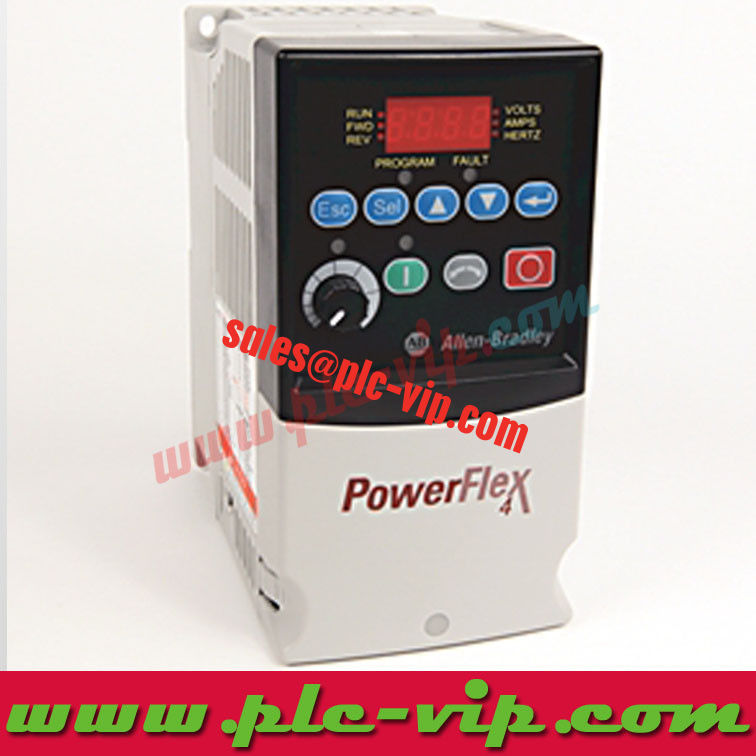
20BN260A0AYNANC0
This page documents catalog number 20BN260A0AYNANC0, a PowerFlex 700 drive in the 325 V DC input class at 260 A. The decode and the class definitions come from the drive family's published catalog number explanation and voltage table; the option region is interpreted only where the family publishes a rule for it.
Decode and published values
| Specification | Value |
|---|
| Catalog number | 20BN260A0AYNANC0 |
| Family (first three characters) | 20B - PowerFlex 700 |
| Input class (fourth character) | N - 325 V DC |
| Precharge as published for this class | N is listed with precharge Y |
| AC class this bus level corresponds to | 240 V AC three-phase, by the 1.35 factor stated as arithmetic on this page |
| Rating code | 260 - 260 A |
| Enclosure field | A - IP20, NEMA/UL Type 1 |
| Brake field, per the family rule | Y fitted / N not fitted; standard on frames 0-3, optional on frames 4-6 |
| Published rating block for this class | ND and HD horsepower and kW per frame, in the DC input block, 325 V DC column |
| Not quoted on this page | kW and frame pairing for this string, because only the 325 V DC column of that block can supply it |
What the class letter settles and what the system settles
The class letter is where the page has to be careful, because N is not one of the two precharged DC entries and it is not one of the two non-precharged ones either. The published voltage table lists N at 325 V DC with precharge Y, and the family's DC block covers 325 V, 540 V, 650 V, 810 V and 932 V, so a 325 V DC drive is the bottom of that set and the one whose bus level sits closest to a low-voltage distribution.
The arithmetic behind the class voltage is worth stating because it is what makes the letter readable for a spare search, and it is arithmetic rather than a published statement: rectifying a three-phase supply gives a bus of roughly 1.35 times the line voltage, so 240 V gives about 325 V, 400 V about 540 V, 480 V about 648 V, 600 V about 810 V and 690 V about 931 V. Read that way the DC letters line up with the AC classes, and a 325 V DC drive is the direct-current counterpart of a 240 V AC drive rather than a separate product line.
Precharge Y on this entry is the fact that carries the most installation weight. A precharged DC class can limit its own inrush when the bus is energised, which is the difference between a drive that can be connected to a live bus and one that needs the charging function built elsewhere in the panel. The two 540 V entries split on this, with H published without precharge and P with it, and the 650 V entries split the same way between J and R.
The rating code reads as the output current, which is the family's convention across the AC and DC classes alike: the three characters after the voltage letter are the ND output amps, with P replacing the decimal point where the value is fractional. A code of 260 therefore reads as 260 A, and that reading is the one part of the string that does not depend on which voltage class it belongs to.
What the page does not do is pair the 260 A code with a specific kW and frame, because the DC input block publishes its ratings per frame with separate ND and HD horsepower and kW columns for each of the five DC voltages, and copying a row across classes is the kind of inference that produces a number nobody can source. Where a buyer needs the kW and frame for this string, they come from that block for the 325 V column, not from a neighbouring class.
The enclosure field A is IP20 and NEMA/UL Type 1 as the family defines it, so the cabinet carries the protection and the thermal duty. At 260 A the drive is a panel-mounted power section rather than a wall unit, and the DC terminals are the interface that matters most: the family's terminal tables list input power, DC+, DC-, BR1, BR2, PE and the motor connections as one group on the larger frames, with the wire range and torque given per frame.
The brake field is the one option character that can be read with confidence, because the family publishes Y and N against brake IGBT and states that the brake is standard on frames 0 to 3 and optional on frames 4 to 6. A string carrying Y is ordered with the brake IGBT, and a string carrying N is not, which on a bus-fed section decides whether the drive can dissipate into a resistor or has to rely on the bus.
The remaining option characters carry communication slot, control type, feedback and documentation. This page does not assign meanings to them, because the string lengths vary across this family and a wrong assignment is a wrong statement about hardware that is actually fitted.
A 325 V DC drive on a shared bus is a system component, and the system questions are the ones that matter: how the bus is charged, what the total connected power is relative to the bus capacitance, and how the sections are coordinated on fault. The catalog number settles the class, the current and the options; it does not settle any of those three.
No lifecycle statement and no price is implied. The class definitions, the precharge entries, the rating-code convention, the enclosure field, the brake rule and the terminal grouping are quoted from the drive family's published documentation; the bus-voltage arithmetic is labelled as arithmetic.
The other drives, reactors and drive spares in this range are collected in the Drives & Motors category. Codes documented alongside this one are 20BR125A3ANNANC0, 20BR156A0ANNANC0, 20BR248A0AYNANC0, and this drive is listed at 20BN260A0AYNANC0.
The twelve 20B voltage codes, and the frames each one is built on
The fourth character of a 20B catalog number is the voltage code, and there are twelve of them: five AC classes and seven DC-bus classes. They are not interchangeable, they do not share frame ranges, and the DC codes additionally split on whether a pre-charge circuit is built in. This table is the complete code list from the 20B-TD001 catalog explanation, with the frame range each class is built on.
| Code | Voltage rating | Frames built on | Where the class is used |
| B | 240 V AC, 3-phase, 50/60 Hz | 0-6 | 208...240 V supply, the North American low-voltage class |
| C | 400 V AC, 3-phase, 50/60 Hz | 0-6 | 380...415 V supply, the European standard class |
| D | 480 V AC, 3-phase, 50/60 Hz | 0-6 | 440...480 V supply, the widest rating ladder of the series |
| E | 600 V AC, 3-phase, 50/60 Hz | 0-6 | 575...600 V supply, Canada and heavy industry |
| F | 690 V AC, 3-phase, 50/60 Hz | 5-6 | 690 V supply, and only on the larger frames |
| H | 540 V DC input, pre-charge | 5-6 | fed from a 540 V DC bus, pre-charge circuit built in |
| J | 650 V DC input | 5-6 | 650 V DC common DC bus, no pre-charge letter |
| N | 325 V DC input (Y), pre-charge | 5-6 | 325 V DC bus, common-bus configuration |
| P | 540 V DC input (Y), pre-charge | 5-8 | 540 V DC common bus, the widest DC frame range |
| R | 650 V DC input (Y), pre-charge | 5-8 | 650 V DC common bus, frames 5 through 8 |
| T | 810 V DC input (Y), pre-charge | 5-6 | 810 V DC bus for 600 V class front ends |
| W | 932 V DC input (Y), pre-charge | 5-6 | 932 V DC bus for 690 V class front ends |
Where this page sits: The fourth character of 20BN260A0AYNANC0 is N: 325 V DC input (Y), pre-charge, frames 5-6 in the catalog explanation, with 260 A in the rating field.
What is missing here is the ladder itself: the rating tables that turn these codes into amp, power and frame steps are printed per voltage class in 20B-TD001, and only the 240, 400 and 480 V classes were transcribed for this site. For 600 V, 690 V and the DC-bus classes the neighbouring current steps are therefore not listed, and none is inferred from another class.
Catalog prefix first: 20B is the PowerFlex 700 prefix and 20A is the PowerFlex 70 prefix. A page filed under a "PowerFlex 70 drives" group while carrying a 20B number is a filing error at the prefix level - the two are different product lines with different frame ranges, not variants of one another. The catalog number on the page decides, not the group label.
Source: 20B-TD001 PowerFlex 700 catalog number explanation (voltage, rating and frame codes) and the 20B-TD001 rating tables. Values are quoted as printed; no figure on this page is calculated or extrapolated.