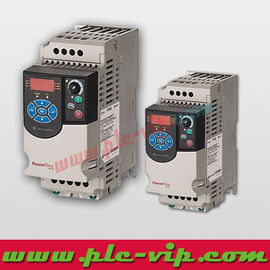
20BH140A0ANNANC0
This page documents catalog number 20BH140A0ANNANC0, a PowerFlex 700 drive in the 540 V DC input class at 140 A on frame 5. The decode and ratings come from the drive family's published catalog number explanation and DC input normal-duty table; the trailing option block is not interpreted beyond the enclosure field.
Decode and published ratings
| Specification | Value |
|---|
| Catalog number | 20BH140A0ANNANC0 |
| Family (first three characters) | 20B - PowerFlex 700 |
| Input class (fourth character) | H - 540 V DC |
| Precharge as published for this class | H is listed with no precharge; the P entry at the same 540 V DC is listed with precharge |
| Rating code (fifth to seventh) | 140 - 140 A |
| Enclosure field (fourth block) | A - IP20, NEMA/UL Type 1 |
| Normal-duty rating, DC input table | 140 A, 75 kW |
| Frame as published | 5 |
| Larger rows in the same table | 365 A, 415 A, 600 A, 730 A and 875 A carry the note that those models are no longer available for sale |
| Output specification basis | Direct-current output rating at the motor terminals, as the DC classes are specified |
What the DC class decides and what it leaves to the system
This is the 140 A code of the 540 V DC PowerFlex 700 range, and the interesting question it raises is not the rating but why the family publishes two 540 V DC classes at all. The string reads 20B for the family, H for the 540 V DC input class, 140 for the output current, and A for the enclosure, which the family defines as IP20 and NEMA/UL Type 1.
The answer to the two-class question is precharging. The platform lists H at 540 V DC with no precharge and P at 540 V DC with precharge, and the same split exists at 650 V DC between J and R. Two drives that a parts list would call identical by voltage and current can therefore differ in whether they can be connected to a bus without external inrush limitation.
The published normal-duty row for this code is 140 A at 75 kW on frame 5 in the DC input table. The rating is a direct-current output figure at the motor terminals; the DC classes are specified that way, which is why the number cannot be compared directly with the alternating input current of an AC-fed drive of similar power.
At 140 A the precharge question becomes a hardware question rather than a documentation question. The DC link capacitance of a drive this size is large enough that an uncontrolled energisation draws a current spike sufficient to weld contactor tips or trip a breaker, and a system that expects the drive to limit it is relying on a function that the H letter says is absent.
Common-bus installations are where these drives live, and the engineering logic of a common bus is that energy recovered by a regenerating section is available to a motoring section instead of being dissipated. A 75 kW section on a shared bus therefore participates in a system whose fault coordination, bus capacitance and precharge sequence are designed as one, and this drive's contribution is its current rating and its frame.
Frame 5 fixes the mechanical facts. Terminal arrangement, clearance for the heatsink and the spare parts set follow the frame, and two codes on the same frame are mechanically interchangeable in a way that two codes on different frames are not, whatever the current difference says.
The option region of the string carries brake IGBT, communication slot, control type, feedback and documentation. This page does not assign a meaning to those characters, because the family's string lengths differ and the position of each field is not constant across them.
The enclosure field A means IP20 and NEMA/UL Type 1, so the cabinet carries the protection. On a frame 5 DC-input drive the cabinet also carries the bus arrangement, the precharge hardware and the coordination with the upstream protection, which is a larger design scope than the drive alone.
A replacement or spare order for this code should state the bus voltage measured at the terminals, the frame, and the duty. The catalog number tells a supplier which family, which class and which current; it does not tell them what the drive will be connected to, and on a DC bus that is the fact that decides whether the unit is usable at all.
No lifecycle statement and no price is implied. The row, the class definition, the precharge pairing and the frame are quoted from the drive family's published tables, and the precharge consequence is stated as a consequence of that definition rather than as a product claim.
There is a documentation habit worth adopting for DC-input drives and it has nothing to do with this page: record the class letter alongside the catalog number in the asset register. Two drives of the same family, current and frame can differ only in the class letter and the precharge pairing, and a register that stores the number without the letter will send the next spare order in the wrong direction.
Seventy-five kilowatts on a shared bus is a section size that appears in converting lines and in test stands, where one axis regenerates while another accelerates. In that arrangement the drive's rating is only half the story: the bus has to absorb the difference, and the precharge arrangement has to survive every energisation the line performs, not only the first.
The other drives, reactors and drive spares in this range are collected in the Drives & Motors category. Neighbouring codes in the same class are listed at 20BH105A0AYNANC0, 20BH170A0ANNANC0, 20BH260A0ANNANC0, and this drive is listed at 20BH140A0ANNANC0.
The twelve 20B voltage codes, and the frames each one is built on
The fourth character of a 20B catalog number is the voltage code, and there are twelve of them: five AC classes and seven DC-bus classes. They are not interchangeable, they do not share frame ranges, and the DC codes additionally split on whether a pre-charge circuit is built in. This table is the complete code list from the 20B-TD001 catalog explanation, with the frame range each class is built on.
| Code | Voltage rating | Frames built on | Where the class is used |
| B | 240 V AC, 3-phase, 50/60 Hz | 0-6 | 208...240 V supply, the North American low-voltage class |
| C | 400 V AC, 3-phase, 50/60 Hz | 0-6 | 380...415 V supply, the European standard class |
| D | 480 V AC, 3-phase, 50/60 Hz | 0-6 | 440...480 V supply, the widest rating ladder of the series |
| E | 600 V AC, 3-phase, 50/60 Hz | 0-6 | 575...600 V supply, Canada and heavy industry |
| F | 690 V AC, 3-phase, 50/60 Hz | 5-6 | 690 V supply, and only on the larger frames |
| H | 540 V DC input, pre-charge | 5-6 | fed from a 540 V DC bus, pre-charge circuit built in |
| J | 650 V DC input | 5-6 | 650 V DC common DC bus, no pre-charge letter |
| N | 325 V DC input (Y), pre-charge | 5-6 | 325 V DC bus, common-bus configuration |
| P | 540 V DC input (Y), pre-charge | 5-8 | 540 V DC common bus, the widest DC frame range |
| R | 650 V DC input (Y), pre-charge | 5-8 | 650 V DC common bus, frames 5 through 8 |
| T | 810 V DC input (Y), pre-charge | 5-6 | 810 V DC bus for 600 V class front ends |
| W | 932 V DC input (Y), pre-charge | 5-6 | 932 V DC bus for 690 V class front ends |
Where this page sits: The fourth character of 20BH140A0ANNANC0 is H: 540 V DC input, pre-charge, frames 5-6 in the catalog explanation, with 140 A in the rating field.
What is missing here is the ladder itself: the rating tables that turn these codes into amp, power and frame steps are printed per voltage class in 20B-TD001, and only the 240, 400 and 480 V classes were transcribed for this site. For 600 V, 690 V and the DC-bus classes the neighbouring current steps are therefore not listed, and none is inferred from another class.
Catalog prefix first: 20B is the PowerFlex 700 prefix and 20A is the PowerFlex 70 prefix. A page filed under a "PowerFlex 70 drives" group while carrying a 20B number is a filing error at the prefix level - the two are different product lines with different frame ranges, not variants of one another. The catalog number on the page decides, not the group label.
Source: 20B-TD001 PowerFlex 700 catalog number explanation (voltage, rating and frame codes) and the 20B-TD001 rating tables. Values are quoted as printed; no figure on this page is calculated or extrapolated.