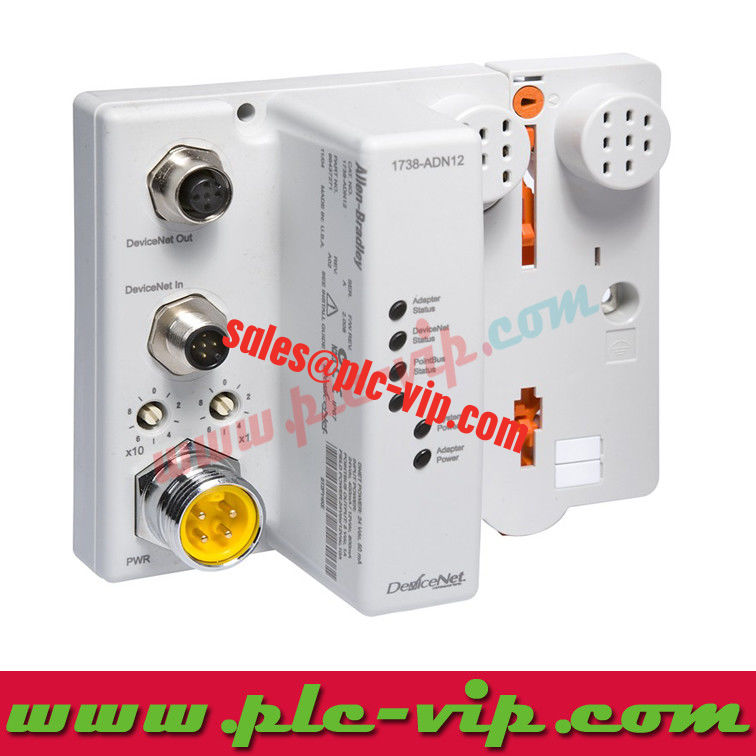
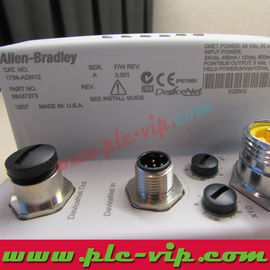
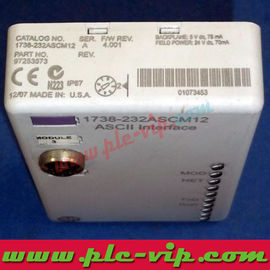
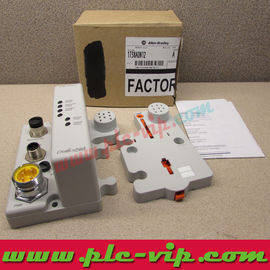
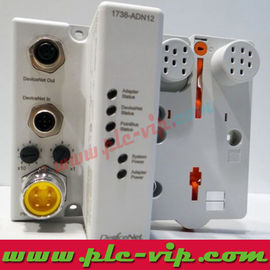
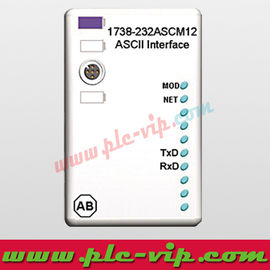
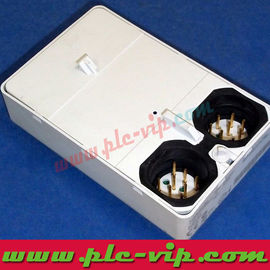
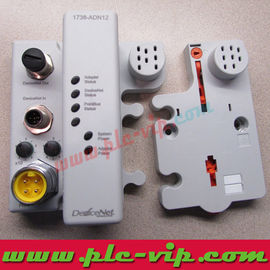
1738-ADN12
This page documents the 1738-ADN12, a DeviceNet adapter with M12 connectors in the ArmorPoint I/O family. The adapter is the network node of a backplane: it holds the MAC ID, the baud rate and the mapping that turns module positions into scanner data, and the figures below are the system specifications published for the ArmorPoint DeviceNet adapters.
Published adapter data
| Field | Value |
| Catalog number | 1738-ADN12 |
| Family | 1738 ArmorPoint I/O, DeviceNet adapter |
| Connectors | M12 (micro) for the DeviceNet drop and the field-power feed |
| Dimensions | 112 H x 72 W x 65 D mm (4.41 x 2.83 x 2.56 in.) |
| Field power bus | 24 V dc nominal, 10 to 28.8 V dc range |
| PointBus | 5 V dc, budgeted per module (75 mA digital and analog, 110 mA for 1738-SSIM23) |
| Isolation | 50 V rms continuous withstand, tested at 1,250 V ac rms for 60 s |
| Operating temperature | -20 to 60 degrees C (-4 to 140 degrees F) |
| Shock and vibration | Operating 30 g, non-operating 50 g; 5 g at 10-500 Hz |
| Maximum modules on a backplane | 63, reachable with additional 1738-EP24DC power modules |
The adapter is the module that makes the backplane a network node: it holds the MAC ID and baud rate for the drop and maps the I/O modules behind it into the scanner.
The M12 body is the compact shell of this pair: it fits a drop where the trunk is already micro, and the cord set that feeds a sensor block plugs into the adapter. That is the choice when the whole network is micro from the trunk down.
Backplane capacity and the two power budgets
A backplane tops out at 63 modules, and in practice that limit is reached through power modules inserted to keep the field budget inside the segment rather than through an adapter that runs out of addresses. Every digital and analog module draws 75 mA at 5 V dc from PointBus, the 1738-SSIM23 draws 110 mA, and that sum is what decides how many modules fit before another 1738-EP24DC goes in.
Field power is a separate budget at 10 to 28.8 V dc, and it is the one that fails first on a segment full of sensors. The adapter and the power modules feed the field side, PointBus feeds the logic side, and a segment planned on one of the two trips on the other at commissioning.
Addressing, baud rate and the subnet decision
The adapter holds the MAC ID for the drop and the baud rate for the network, and autobaud is a setting rather than a default that can be relied on. On the 1738-ADNX the adapter also runs a subnet behind itself, which is the architecture that lets modules off the backplane keep their own baud rate and MAC ID; it then builds a scanlist from what it finds and maps data along byte, word or double-word boundaries.
Auto Start Mode is the convenience that is easy to misread: while it runs, the adapter reports an auto-start state and refuses I/O allocation from a scanner, so the parameter has to be returned to a do-nothing value afterwards. A segment left in auto start is a segment a scanner cannot allocate, and the symptom looks like a network fault rather than a commissioning step that was not finished.
Environment and installation facts that repeat across the family
| Parameter | Value |
| Dimensions with base | 120 H x 72 W x 42 D mm (4.72 x 2.83 x 1.65 in.) for I/O modules; 112 H x 72 W x 65 D mm (4.41 x 2.83 x 2.56 in.) for the DeviceNet adapters |
| Enclosure rating | Meets IP65/66/67 when marked; the sealed housing needs no cabinet, though a plant with washdown or corrosive atmosphere can still require one |
| Operating temperature | -20 to 60 degrees C (-4 to 140 degrees F), IEC 60068-2-1 cold, 60068-2-2 dry heat and 60068-2-14 thermal shock |
| Storage temperature | -40 to 85 degrees C (-40 to 185 degrees F) |
| Relative humidity | 5 to 95 percent non-condensing, IEC 60068-2-30 damp heat |
| Shock and vibration | Operating 30 g, non-operating 50 g; 5 g at 10-500 Hz operating |
| Isolation | 50 V rms continuous withstand, tested at 1,250 V ac rms for 60 s |
| ESD and RF immunity | 6 kV contact and 8 kV air discharge, 10 V/m radiated RF from 30 MHz to 2,000 MHz, 10 Vrms conducted RF from 150 kHz to 80 MHz |
| Transient immunity | Plus or minus 3 kV at 5 kHz EFT on signal ports, plus or minus 1 kV line-to-line and plus or minus 2 kV line-to-earth surge |
| Emissions | CISPR 11 Group 1 Class A |
| Mounting | Mounted on a grounded metal plate with #8 (M4) screws; base torque 7.5 in-lb in aluminium and 16 in-lb in steel; the ground lug is also a mounting hole |
| Weight | 0.29 kg (0.64 lb) with base |
| Field power bus | 24 V dc nominal, 10 to 28.8 V dc range |
| PointBus current | 75 mA at 5 V dc for digital and analog modules, 110 mA for 1738-SSIM23 |
Mounting is part of the electrical path: the module sits on a base, the base is fixed to a grounded metal plate with #8 (M4) screws, and the ground lug is also a mounting hole. The conductive path therefore runs through the base and the plate rather than through the module, which is why a module swapped onto a dirty base measures as a missing earth and reads like an electronics fault.
The family is built so the module is the replaceable unit and the base stays on the machine. The keyswitch position on the base has to match the module class, and a module inserted one position off is not a wiring error that can be traced with a meter but a mapping error that appears as shifted channels. That is the difference between a field-wired rack and a sealed I/O system: there is no terminal strip to inspect, only the position and the adapter map.
Same class, other connector shells
The same electrical function is published under other strings in this family: 1738-ADN18, 1738-ADN18P, 1738-ADNX. A substitution between them is a change of shell and cord-set preparation rather than a change of channel behaviour, and the keyswitch position is what has to stay compatible with the base already on the machine.
Service on a sealed block is a connector job rather than a terminal job: the cord sets come off, the module comes off the base, and the base stays bolted to the machine. That is why the spare is a module rather than a complete assembly, and why a cord-set keying mistake shows up as a channel swap instead of a wiring error a meter can find.
Two spares cover most of this family: one digital input block and one digital output block, both in the connector shell the plant already uses. The shells are not interchangeable with the existing cable preparation, so the spare has to match the shell on the machine rather than only the channel count.
The family is designed so that the module is the replaceable unit and the base stays on the machine. That is why the base is ordered with the module, why the keyswitch on the base has to match the module class, and why the ground lug is also a mounting hole: the conductive path runs through the base and the plate rather than through the module. Swapping a module onto a dirty base is the failure that looks like a module fault and measures as a missing earth.
The default data map matters as much as the rating: a digital module produces one byte and, for outputs, consumes one, and that byte is the channel status and output state the controller actually sees.
What this page does not claim matters as much as what it does. It states no cycle time, no maximum cable length and no network baud rate for this catalog number, because those belong to the segment and the adapter rather than to the module, and a figure of that kind copied into a page becomes a specification nobody can trace back to a publication. Where the source documents do fix a value - the channel count, the shell, the current limit, the isolation rating, the temperature window, the data size - it is on this page with the publication named.
No lifecycle statement and no price is implied. The electrical, environmental and data-map figures are quoted from the ArmorPoint installation instructions (1738-IN001 for dc outputs, 1738-IN002 for dc inputs, 1738-IN003 for analog inputs and the temperature input instructions) and the DeviceNet adapter user manual 1738-UM001.