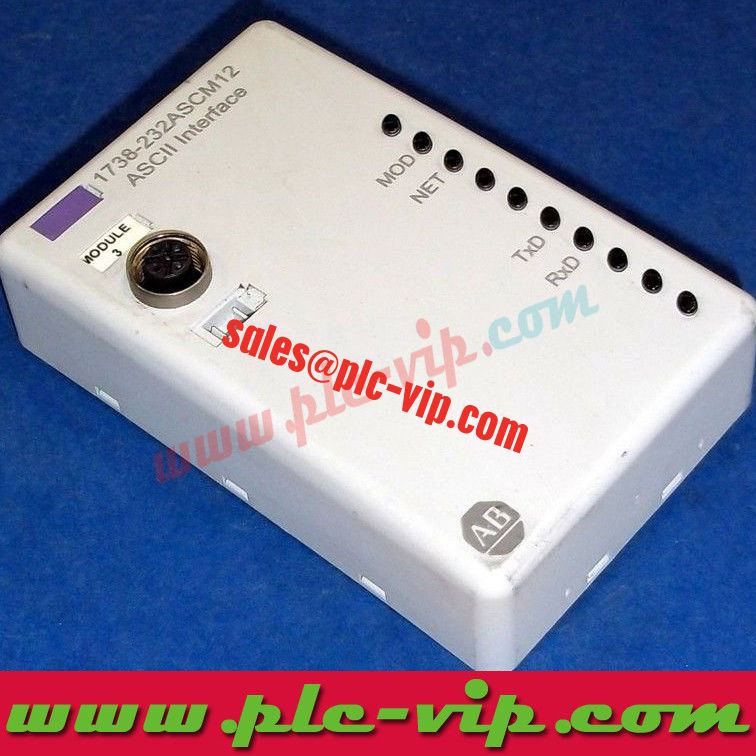
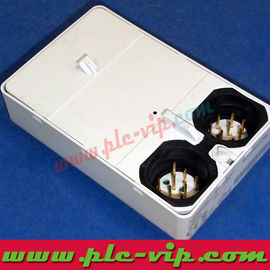
1738-232ASCM12
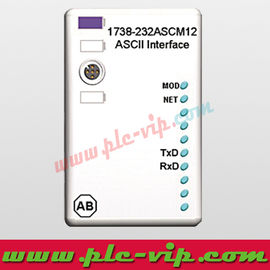
This page documents catalog number 1738-232ASCM12, a RS-232 ASCII module, M12 connector in the ArmorPoint I/O family. It is the RS-232 member of the serial family: a sealed IP67 module that puts one RS-232 port on the backplane and exchanges that port with the master as polled, cyclic or change-of-state data. The figures below are quoted from the installation instructions for this module.
What the module is and where it sits
| Field | Value |
| Number of inputs | 1, full duplex |
| Connector | M12 (micro), 5-pin: pin 1 no connect, pin 2 Tx plus, pin 3 Rx plus, pin 4 common, pin 5 no connect |
| Signal levels to signal ground | 0 asserted, ON, space: plus 3 to plus 25 V dc; 1 deasserted, OFF, mark: minus 3 to minus 25 V dc |
| External supply | 24 V dc nominal, 10 to 28.8 V dc range, 15 mA at 24 V dc, fault protected to 28.8 V dc |
| Serial framing | 7N2, 7E1, 7O1, 8N1, 8N2, 8E1, 8O1, 7E2, 7O2 |
| Serial speed | 1200, 2400, 4800, 9600, 19.2k, 38.4k baud |
| Characters per record | 1 to 128 received and 1 to 128 transmitted |
| Assembly size | 4 to 132 bytes produced, 4 to 132 bytes consumed |
| Dimensions | 111.6 x 71.6 x 38.4 mm (4.39 x 2.82 x 1.51 in.), 216 g |
| Keyswitch position | 2 (specialty) |
| PointBus current | 75 mA at 5 V dc |
| Power dissipation | 0.75 W at 28.8 V dc (2.5 BTU/hr) |
| Isolation | 50 V rms continuous, type tested at 1,250 V ac rms for 60 s |
| Enclosure | Meets IP65/66/67/69K when marked |
| Wiring category | 2 on communications ports |
What the published figures mean in a project
The three-wire connection is the whole interface: transmit, receive and common on pins 2, 3 and 4, with the polarity fixed by the module rather than by a jumper. A device that needs hardware handshaking does not connect here, and that is a selection decision made before the catalog number is ordered.
Levels are plus or minus 3 to 25 V dc measured to signal ground, which is the RS-232 window rather than a TTL one, and the module publishes the asserted state as positive and the deasserted state as negative. An RS-232 device that idles negative is read correctly without an inverter, and a TTL device needs a converter at the device, not at the module.
The record handling is the same as the RS-485 member of the family: 1 to 128 characters each way, start and end delimiters that can be excluded, included or absent, 16, 24 or 32 bit swapping, padding, and 4 to 132 byte assemblies. The status reports transmit and receive FIFO overflow, parity error, handshake error and a new-data flag, which is how a dropped record is distinguished from a device that never answered.
Environment and installation facts that repeat across the family
| Parameter | Value |
| Dimensions with base | 120 H x 72 W x 42 D mm (4.72 x 2.83 x 1.65 in.) for I/O modules; 112 H x 72 W x 65 D mm (4.41 x 2.83 x 2.56 in.) for the DeviceNet adapters |
| Enclosure rating | Meets IP65/66/67 when marked; the sealed housing needs no cabinet, though a plant with washdown or corrosive atmosphere can still require one |
| Operating temperature | -20 to 60 degrees C (-4 to 140 degrees F), IEC 60068-2-1 cold, 60068-2-2 dry heat and 60068-2-14 thermal shock |
| Storage temperature | -40 to 85 degrees C (-40 to 185 degrees F) |
| Relative humidity | 5 to 95 percent non-condensing, IEC 60068-2-30 damp heat |
| Shock and vibration | Operating 30 g, non-operating 50 g; 5 g at 10-500 Hz operating |
| Isolation | 50 V rms continuous withstand, tested at 1,250 V ac rms for 60 s |
| ESD and RF immunity | 6 kV contact and 8 kV air discharge, 10 V/m radiated RF from 30 MHz to 2,000 MHz, 10 Vrms conducted RF from 150 kHz to 80 MHz |
| Transient immunity | Plus or minus 3 kV at 5 kHz EFT on signal ports, plus or minus 1 kV line-to-line and plus or minus 2 kV line-to-earth surge |
| Emissions | CISPR 11 Group 1 Class A |
| Mounting | Mounted on a grounded metal plate with #8 (M4) screws; base torque 7.5 in-lb in aluminium and 16 in-lb in steel; the ground lug is also a mounting hole |
| Weight | 0.29 kg (0.64 lb) with base |
| Field power bus | 24 V dc nominal, 10 to 28.8 V dc range |
| PointBus current | 75 mA at 5 V dc for digital and analog modules, 110 mA for 1738-SSIM23 |
The family is designed so that the module is the replaceable unit and the base stays on the machine. That is why the base is ordered with the module, why the keyswitch on the base has to match the module class, and why the ground lug is also a mounting hole: the conductive path runs through the base and the plate rather than through the module. Swapping a module onto a dirty base is the failure that looks like a module fault and measures as a missing earth.
The default data map matters as much as the rating: a digital module produces one byte and, for outputs, consumes one, and that byte is the channel status and output state the controller actually sees.
What this page does not claim matters as much as what it does. It does not invent a cable length, a loop length or a scan time for this catalog number, because those follow from the device on the other end of the connector and from the segment; only what the source publication states is printed here.
No lifecycle statement and no price is implied. The electrical, environmental and data-map figures are quoted from the ArmorPoint installation instructions, and a figure absent from this page is absent from the publication for this catalog number.
PointBus budget: how many 1738-232ASCM12 modules one segment carries
Every module in this family takes its 5 V PointBus current from the adapter, and the adapter publishes a 1.0 A budget with 1.3 A added per 1738-EP24DC. The table turns that into a module count for this page's printed draw, which is the arithmetic done when a segment is planned rather than after it browns out.
| Configuration | PointBus available | Modules at 75 mA | What that means |
| 1738-APB or 1738-ACNR alone | 1,000 mA | 13 | adapter budget, no expansion supply |
| Adapter plus one 1738-EP24DC | 2,300 mA | 30 | one supply fitted after the first bank |
| Adapter plus two 1738-EP24DC | 3,600 mA | 48 | two supplies, two extra banks |
| 63-module station, printed ceiling | 4725 mA at 75 mA | 63 | 3 expansion supplies needed |
Where this module sits: 1738-232ASCM12 draws 75 mA on the PointBus, which is band 1 of the seven published classes. A full 63-module station of this type is 4725 mA and needs 3 expansion supplies, which is the number to check before the module list is fixed.
Read the three capacity rows from the top down and the shape of the decision is visible: the first supply more than doubles what the adapter carries, the second adds a fixed 1.3 A again, and the 63-module ceiling has to be checked separately because it binds at a different point for each class.
What the printed data does not carry: this page prints no start-up or inrush current on the PointBus and no maximum number of modules between two power supplies, so the table sizes steady-state load only. The 5 to 17 module reach is printed for the 1738-EP24DC, not for the modules it feeds.
Source: Rockwell publication 1738-IN001, adapter and expansion power supply PointBus budgets; the module count is 1,000 mA, 2,300 mA and 3,600 mA divided by this page's printed 75 mA. No figure here is estimated.