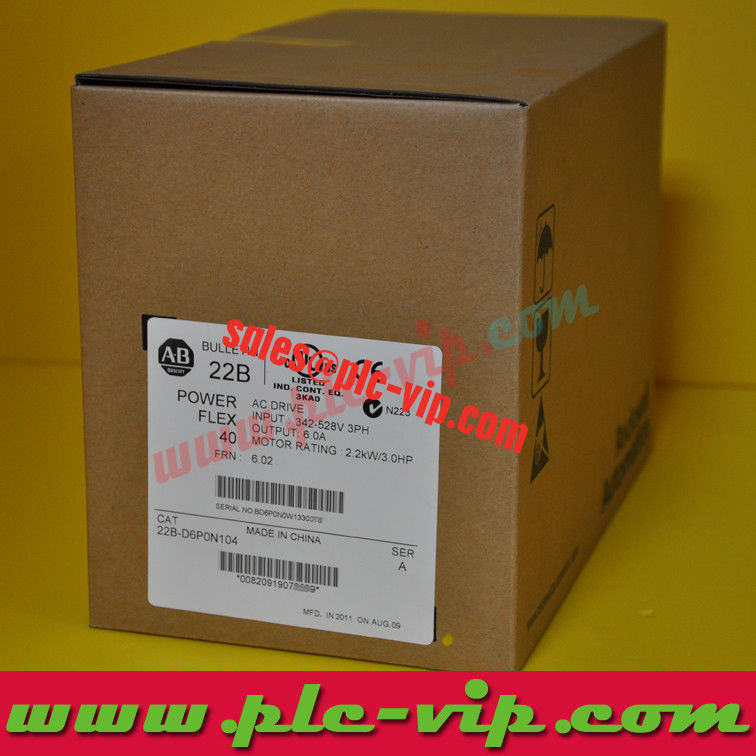
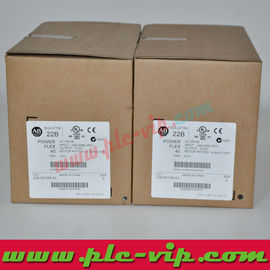
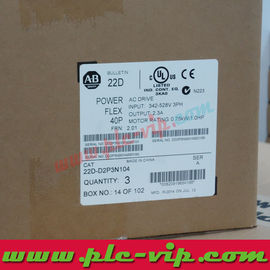
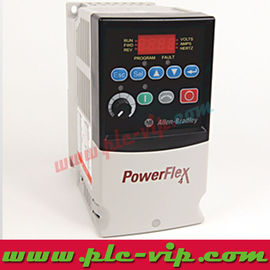
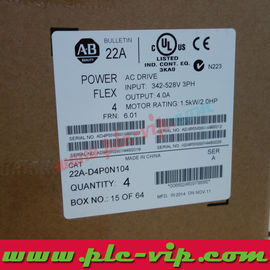
22C-B024H103
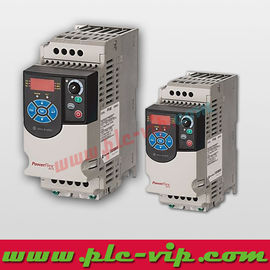
This page documents the 22C-B024H103, a PowerFlex 400 fan and pump drive. The number decodes position by position: 22C is the series, B fixes the 200...240 V AC three phase input, 024 is the rating code that sets 24.0 A and 5.5 kW (8 HP) in frame C, H is the enclosure (not printed in the 22C enclosure table), and 103, the standard build ending used at both voltages and every frame closes the number.
Catalog number, position by position
| Position | Value |
| 1-3 | 22C, PowerFlex 400 adjustable frequency drive for fan and pump applications |
| 4 | B, 200...240 V AC three phase |
| 5-7 | 024, 24.0 A output current and 5.5 kW (8 HP), frame C |
| 8 | H, not printed in the 22C enclosure table |
| 9-12 | 103, the standard build ending used at both voltages and every frame |
Rating data for this number
| Attribute | Value |
| Output current | 24.0 A |
| Motor rating | 5.5 kW (8 HP), variable torque fan and pump duty |
| Frame | C |
| Power terminal range, frame C | 8.4 mm2 (8 AWG) maximum, 1.3 mm2 (16 AWG) minimum, recommended torque 3.7 N.m (33 lb.in) |
| Input voltage | 200...240 V AC |
| Ambient, panel mount | 45 C (113 F) surrounding air, IP20 open and IP30 Type 1 |
A caution on this number: the published 22C catalog number explanation lists only N (IP20 open), A (IP30 Type 1) and F (flange) in the enclosure position, and H is not among them. The rating percentages attached to 24.0 A and 5.5 kW are unaffected, but the enclosure letter should be read off the unit nameplate rather than inferred from this page.
Ratings either side of this one
The published table places this rating between 017: 17.5 A, 3.7 kW (5 HP), frame C; 033: 33.0 A, 7.5 kW (10 HP), frame C. When a fan or pump is re-rated, these are the two numbers the drive is compared with, and the frame letter in each case tells you whether the terminal block changes along with the current.
Direct links to the neighbouring ratings in this voltage class: 22C-B017, 22C-B033.
What the current figure does and does not cover. The output current in the table is the drive rating at the published ambient and switching conditions. Motor current on a fan varies with speed and air density, so a drive sized exactly to the motor nameplate can be short of current on a cold day at full speed; the margin is a design decision, and the table gives the ceiling it has to fit under.
Terminals follow ul, the installation code may not. Power terminals are sized according to UL, and the publication states that local or national codes may require a larger conductor than the terminal accepts, in which case multiple conductors, 90 C wire or lugs are used. The wire range in the frame table is a terminal limit; the run to the motor is a separate calculation done against the installation code in force.
The same ratings exist as packaged numbers. The same ratings appear as packaged 23C catalog numbers with disconnect, circuit breaker and bypass configurations. The drive selection does not change; the short circuit protection, the enclosure and the factory wiring do. A panel builder comparing a bare 22C drive with a packaged number is comparing scope, not two different drives.
The 103 ending is the standard build. Every standard drive in the published selection tables ends in 103, at both voltages and across every frame, so the ending is not an option code. Options change it by adding characters, and those options are listed separately as user installed equipment. A number that does not end in 103 is therefore worth reading against that option list rather than against the rating table.
480 v input window in the tables. The 380...480 V AC drives carry a 340...528 V AC input window in the rating tables, wider than the voltage on the nameplate. A loaded transformer sagging to 350 V during a large fan start stays inside that window, and a site running near 500 V stays inside it too; a site above 528 V does not, and that is a transformer tap question rather than a drive question.
Frame C in practice. Frame C is the frame that changes character with the enclosure code. It ships as IP20 open and reaches IP30 Type 1 only through a field installed conversion kit with a top cover and conduit box, and it is the only frame where flange mounting is available at the lower ratings. The terminal block takes up to 8 AWG at 3.7 N.m, so a 5 HP fan on a long run is a wire size question rather than a lug question.
The boundary of the published data. Everything printed here comes from the 22C technical data, including the frame terminal ranges and the ambient statement. Anything an application needs beyond that, such as the motor cable length limit or the earth fault behaviour, is in the user manual for this range and not in the sales tables.
Environmental and installation context
| Parameter | Value |
| Dimensions with base | 120 H x 72 W x 42 D mm (4.72 x 2.83 x 1.65 in.) for I/O modules; 112 H x 72 W x 65 D mm (4.41 x 2.83 x 2.56 in.) for the DeviceNet adapters |
| Enclosure rating | Meets IP65/66/67 when marked; the sealed housing needs no cabinet, though a plant with washdown or corrosive atmosphere can still require one |
| Operating temperature | -20 to 60 degrees C (-4 to 140 degrees F), IEC 60068-2-1 cold, 60068-2-2 dry heat and 60068-2-14 thermal shock |
| Storage temperature | -40 to 85 degrees C (-40 to 185 degrees F) |
| Relative humidity | 5 to 95 percent non-condensing, IEC 60068-2-30 damp heat |
| Shock and vibration | Operating 30 g, non-operating 50 g; 5 g at 10-500 Hz operating |
| Isolation | 50 V rms continuous withstand, tested at 1,250 V ac rms for 60 s |
| ESD and RF immunity | 6 kV contact and 8 kV air discharge, 10 V/m radiated RF from 30 MHz to 2,000 MHz, 10 Vrms conducted RF from 150 kHz to 80 MHz |
| Transient immunity | Plus or minus 3 kV at 5 kHz EFT on signal ports, plus or minus 1 kV line-to-line and plus or minus 2 kV line-to-earth surge |
| Emissions | CISPR 11 Group 1 Class A |
| Mounting | Mounted on a grounded metal plate with #8 (M4) screws; base torque 7.5 in-lb in aluminium and 16 in-lb in steel; the ground lug is also a mounting hole |
| Weight | 0.29 kg (0.64 lb) with base |
| Field power bus | 24 V dc nominal, 10 to 28.8 V dc range |
| PointBus current | 75 mA at 5 V dc for digital and analog modules, 110 mA for 1738-SSIM23 |
The family is designed so that the module is the replaceable unit and the base stays on the machine. That is why the base is ordered with the module, why the keyswitch on the base has to match the module class, and why the ground lug is also a mounting hole: the conductive path runs through the base and the plate rather than through the module. Swapping a module onto a dirty base is the failure that looks like a module fault and measures as a missing earth.
The sealed housing is the reason this family exists. An IP67 module on a machine frame removes the cabinet from the field side of the design, and the price of that is that every environmental claim is made per module rather than per enclosure.
Figures on this page are the published 22C technical data for this catalog number. Where a value is not printed in that publication it is not printed here either, and no price, lead time or lifecycle statement is implied.