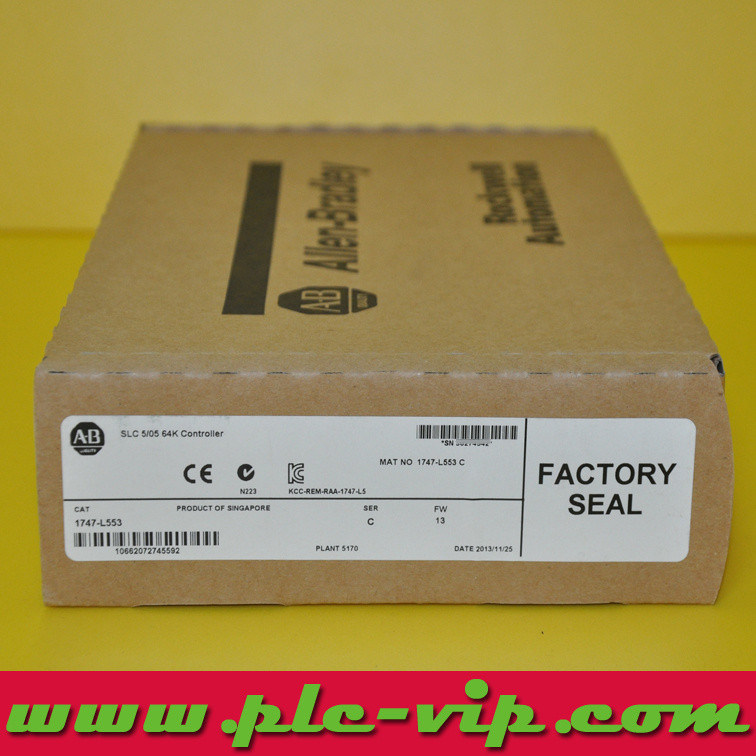
1747-PSD SLC Program Storage Device
Category:
PLCs, Power Supplies & I/Os
Manufacturer:
Rockwell
Group:
SLC 500 System 1747
1747-PSD is the SLC Program Storage Device.
Program storage accessory catalog number. Rockwell's page is withdrawn and prints no memory figure.
Product Specifications 1747-PSD (PDF)
Catalog number |
1747-PSD |
Description |
SLC Program Storage Device |
Product type |
Program storage accessory |
Discontinued date |
Not published |
Replacement category |
Not published |
Publication |
1747-UM011 |
1747-PSD (SLC 500 Program Storage Device): a standalone 64 K-word flash EPROM program store that uploads and downloads programs to SLC 5/03 and higher processors and to MicroLogix 1000/1100/1200/1500 controllers over a 9-pin RS-232 D-shell, running on two AAA batteries or 7...30 V DC at 250 mA, with 1747-CP3 and 1761-CBL-PM02 as the compatible cables (not included).
It exists so that a machine can be restored without a laptop or a copy of RSLogix 500 on site: the program is pulled from the controller, kept in flash EPROM even if the batteries or the supply fail, and pushed back after a processor swap. Before downloading it error-checks that the stored program matches the target controller, and it auto-detects the baud rate with CRC or BCC checking, so the field technician only has to plug it in and press go. Source: Rockwell publication 1747-SG001 (program storage device specifications).
Attribute values above are reproduced from the manufacturer's product data. For the authoritative technical record see Rockwell publications 1747-UM011 (module specifications) and 1747-UM011 (installation instructions). Certification details, with certificate and file numbers, are listed in the FAQ below.
What the catalog number covers
Program storage accessory catalog number. Rockwell's page is withdrawn and prints no memory figure.
It belongs to the 1747 accessory range that surrounds the SLC 500 modular platform rather than to the processors, the I/O modules or the rack supplies themselves.
What is documented and what is not
Rockwell's product page for this catalog number is not available, and no publication in the 1747 set prints an electrical rating for it. That is why this page carries a catalog number, a description and a lifecycle note rather than a specification table.
Where a figure is missing, it is marked as not published instead of being filled from a distributor listing. A distributor description is not a Rockwell specification, and a number taken from one has no traceable source.
Where it is used
Accessories in this range are fitted alongside a 1746 chassis or a programming workstation: they support commissioning, demonstration or program handling rather than machine control.
Because the item is not part of the control path, its exact revision is less critical than its completeness: a kit that is missing a component is worth less than the catalog number suggests.
Buying a withdrawn accessory
Ask for the physical label, the packaging and any disk or documentation that came with the item, and compare the catalog number character by character. Accessory numbers in this range differ by a single digit and are easy to confuse.
For anything that will be used in a live panel rather than on a bench, confirm the function against a Rockwell publication before fitting it. This page deliberately does not assert a function beyond what the catalog record supports.
Lifecycle status
No discontinued date and no replacement category are printed on record for this catalog number, and Rockwell's product page has been withdrawn.
Treat it as a legacy item: usable as a spare for an existing installation, not as a component of a new design.
FAQ — 1747-PSD
What is 1747-PSD?
SLC Program Storage Device. Program storage accessory catalog number. Rockwell's page is withdrawn and prints no memory figure.
Is 1747-PSD still available from Rockwell?
Rockwell's product page is withdrawn and no discontinued date is printed on record.
What specification is published for 1747-PSD?
None in the 1747 publication set. The catalog number, description and lifecycle note are what is on record.
Can 1747-PSD be used in a new design?
No. It is a legacy accessory for existing SLC 500 installations.
What should be checked before buying?
The physical label and the full catalog number, plus any documentation or media that belong to the item.
Data sources. The 1747 accessory catalog numbers below are documented only at catalog level: the Rockwell product pages for these numbers have been withdrawn, so no electrical rating is printed here. Any attribute a publication does not print is marked Not published rather than taken from a distributor page. Catalog number, packaging and stock status are the stock record of this listing.