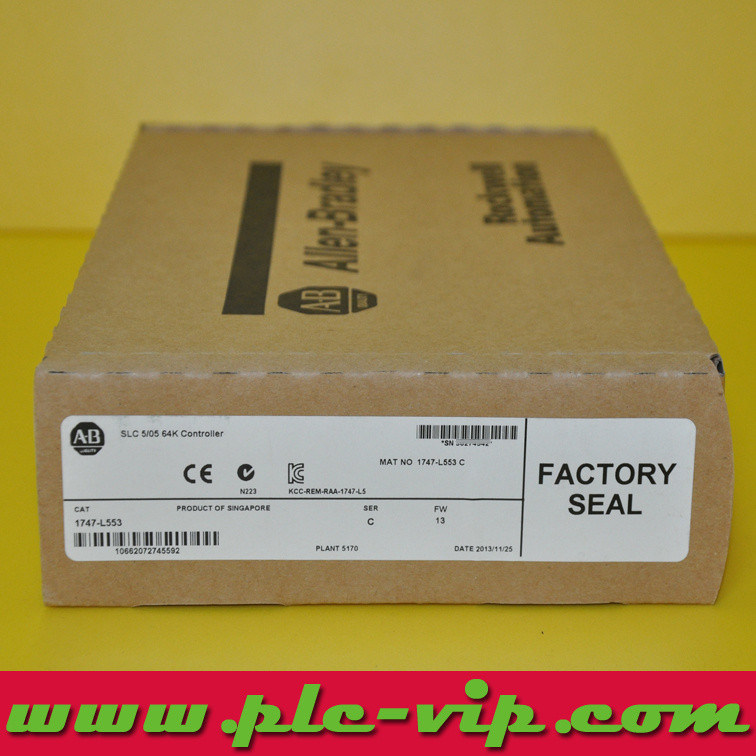
1747-OS401 SLC 5/04 Firmware Upgrade Module
Category:
PLCs, Power Supplies & I/Os
Manufacturer:
Rockwell
Group:
SLC 500 System 1747
1747-OS401 is the SLC 5/04 Firmware Upgrade Module, used with SLC 5/04 processors (1747-L542, 1747-L543).
Rockwell discontinued the catalog number on 2022-12-31, replacement category Engineering Replacement.
Product Specifications 1747-OS401 (PDF)
Catalog number |
1747-OS401 |
Description |
SLC 5/04 Firmware Upgrade Module |
Used with |
SLC 5/04 processors (1747-L542, 1747-L543) |
Discontinued date |
2022-12-31 |
Replacement category |
Engineering Replacement |
Publication |
1747-IN007 / 1747-UM011 |
Attribute values above are reproduced from the manufacturer's product data. For the authoritative technical record see Rockwell publications 1747-IN007 (module specifications) and 1747-IN007 (installation instructions). Certification details, with certificate and file numbers, are listed in the FAQ below.
What a firmware upgrade module is for
The operating system of an SLC 5/03 or 5/04 processor lives in flash memory that can be reloaded in the field. This kit is the licensed route to that reload: it carries the operating system release for the processor series named on the label.
It is not a program memory module. Nothing of the user program travels with it; the program stays in RAM and in the EEPROM or Flash EPROM module fitted to the processor.
Which processor it serves
This kit is listed for SLC 5/04 processors (1747-L542, 1747-L543). The operating system release must match the processor series; a 5/03 release cannot be loaded into a 5/04 and vice versa.
During the download the RUN and FLT indicators stay off and the other four status indicators walk in sequence. Rockwell prints the download as taking up to 2.5 minutes. Interrupting it leaves the processor without a usable operating system, so the rack must not be power-cycled mid-transfer.
What the upgrade changes
An operating system release changes instruction support, communication behaviour and diagnostic depth. On the 5/04, the OS401 release is the one that enables DH+ to DF1 full-duplex passthru, which is why plants that need that bridge look for OS401 specifically.
Because the release level is what a spare processor reports in the programming software, the module matters for compatibility work as much as for repair: two processors at different release levels can behave differently on the same network.
Before and after the upgrade
Save the program and the processor configuration to disk, and confirm the memory module holds a current copy, before touching the operating system. The upgrade does not preserve anything you have not stored.
After the download, check the release level reported online, run the machine through a full cycle, and only then put the rack back into production. A processor that boots but rejects its I/O configuration is usually a configuration that was written by the older release.
Lifecycle status
Discontinued 2022-12-31, replacement category Engineering Replacement. Rockwell publishes no like-for-like successor kit for this catalog number, so the practical spares plan is to keep a matched release on the shelf.
A used kit is only worth buying if the release level it carries is the one the plant needs; the media are not interchangeable, and a kit for a different series will not load.
FAQ — 1747-OS401
Which processor does 1747-OS401 serve?
It is listed for SLC 5/04 processors (1747-L542, 1747-L543).
Does the upgrade module carry the user program?
No. It carries the operating system release only.
Is 1747-OS401 still sold by Rockwell?
No. Rockwell lists it as discontinued 2022-12-31, replacement category Engineering Replacement.
How long does the download take?
Up to 2.5 minutes, according to 1747-UM011.
What should be saved before upgrading?
The program and processor configuration, plus a current copy on the memory module.
Data sources. The operating system behaviour described here is printed in 1747-UM011 (firmware upgrade chapter) and in the Rockwell product page of the catalog number. Any attribute a publication does not print is marked Not published rather than taken from a distributor page. Catalog number, packaging and stock status are the stock record of this listing.