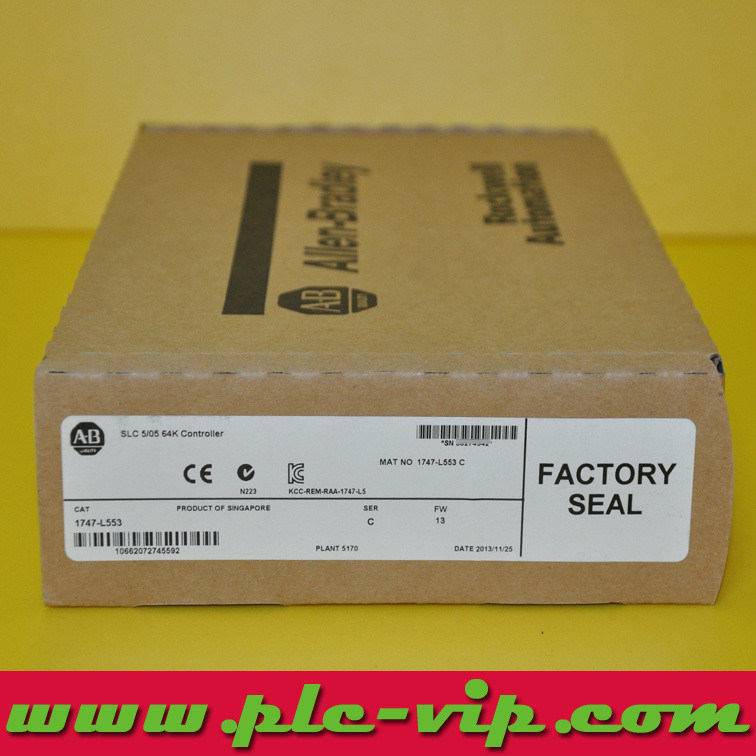
1747-M13 64 K EEPROM Memory Module
Category:
PLCs, Power Supplies & I/Os
Manufacturer:
Rockwell
Group:
SLC 500 System 1747
1747-M13 is a 64 K EEPROM Memory Module for the SLC 500 modular platform: 64 K user memory back-up, used with SLC 5/03 (1747-L531/L533), SLC 5/04 (1747-L542/L543), SLC 5/05 (1747-L551/L552/L553).
Flash EPROM module for the later processors; adapter socket 1747-M15 Series B is required to program it in a commercial PROM programmer.
Product Specifications 1747-M13 (PDF)
Catalog number |
1747-M13 |
Description |
64 K EEPROM Memory Module |
Capacity |
64 K user memory back-up |
Used with |
SLC 5/03 (1747-L531/L533), SLC 5/04 (1747-L542/L543), SLC 5/05 (1747-L551/L552/L553) |
Module type |
EEPROM / Flash EPROM |
Discontinued date |
2024-03-31 |
Replacement category |
No planned RA replacement |
Replacement product |
None published |
Publication |
1747-IN010 / 1747-UM011 |
Attribute values above are reproduced from the manufacturer's product data. For the authoritative technical record see Rockwell publications 1747-IN010 (module specifications) and 1747-IN010 (installation instructions). Certification details, with certificate and file numbers, are listed in the FAQ below.
What the module does in an SLC 500 system
A memory module is the non-volatile copy of the processor program. The processor RAM keeps the live program; the module holds a copy that survives a dead battery and a rack that has been powered down for a season. In practice it is what lets a machine be recommissioned after a long shutdown without a laptop.
Rockwell describes the flow as save, load and transfer: the program is stored into the module through the programming software, loaded back into RAM from the module, or archived through the software PROM translator utility. The module is readable and writable by the processor itself, so no external programmer is needed for a routine backup.
Capacity and which processors accept it
This module is rated 64 K user memory back-up and is listed for SLC 5/03 (1747-L531/L533), SLC 5/04 (1747-L542/L543), SLC 5/05 (1747-L551/L552/L553). Capacity matters because the module must at least cover the program the processor actually holds; a module smaller than the program cannot store a complete image.
The module plugs into a socket on the processor. Nothing else in the rack changes: the chassis, the power supply and the I/O modules are untouched by fitting or removing a memory module.
Programming the module outside the processor
To write the module in a commercial PROM programmer, Rockwell requires an adapter socket: 1747-M5 for the M1 and M2 EEPROMs, 1747-M15 Series B for the 1747-M13 Flash EPROM. Without the correct socket the module cannot be seated in the programmer, which is the usual reason a spare module appears to be dead.
A Flash EPROM module can be left write-protected or unprotected, set either in the software or in the programmer. That choice decides whether the module can be overwritten in the field or only read back.
Fitting and handling
Remove rack power before pulling the processor cover and the module. The socket is keyed, so the module seats one way only; forcing it is the fastest way to bend a pin. Handle the module by the plastic housing, not the board edge.
After fitting, confirm the processor reports the module correctly and that a store and load cycle completes before the machine is handed back. A module that stores but does not load is worse than no module at all, because it looks like a valid backup.
Lifecycle status
Rockwell's status for this catalog number is: discontinued 2024-03-31, replacement category No planned RA replacement.
Memory modules are consumable spares rather than repairable assemblies. What is normally bought on the secondary market is a tested module with a known program image, or a blank module to be programmed on site.
FAQ — 1747-M13
What capacity is 1747-M13?
64 K user memory back-up.
Which processors accept 1747-M13?
It is listed for SLC 5/03 (1747-L531/L533), SLC 5/04 (1747-L542/L543), SLC 5/05 (1747-L551/L552/L553).
Is 1747-M13 still available from Rockwell?
Rockwell's status on record is discontinued 2024-03-31, replacement category No planned RA replacement.
Does the module need a PROM programmer socket?
Yes, if it is programmed outside the processor: 1747-M5 for the EEPROM pair, 1747-M15 Series B for the 1747-M13.
What happens to the program if the processor battery dies?
RAM content is lost. The program is then restored from this module, which is the reason the module is kept fitted and current.
Data sources. Capacities and processor compatibility come from the EEPROM memory module table in 1747-UM011 and from the Rockwell product page of each catalog number. Withdrawn pages are marked as such instead of being filled from distributor data. Any attribute a publication does not print is marked Not published rather than taken from a distributor page. Catalog number, packaging and stock status are the stock record of this listing.