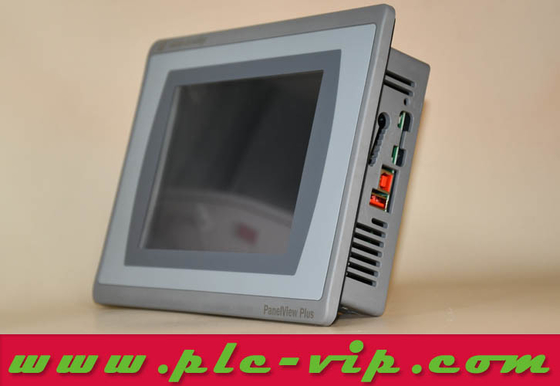
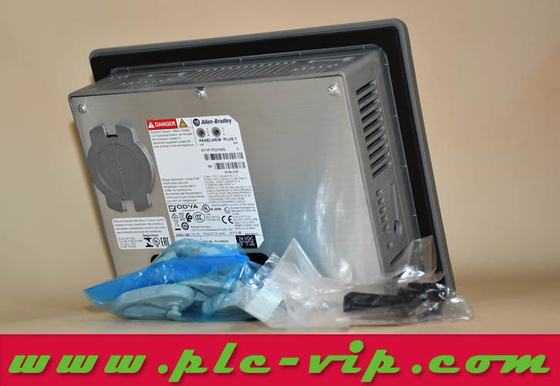
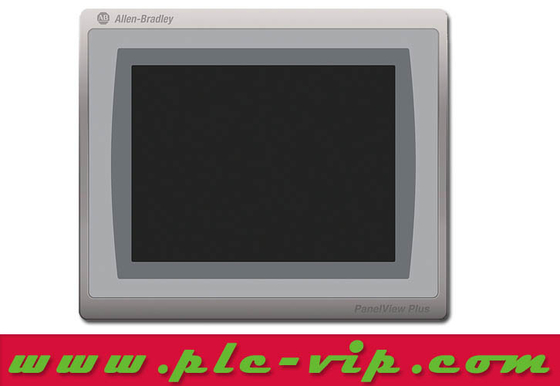
2711P-T10C22D8S-B
This page documents catalog number 2711P-T10C22D8S-B, the dual Ethernet port model of the PanelView Plus 7 Standard 10 terminal, supplied as the Brandless variant. The attributes below are the ones the manufacturer publishes for this catalog number; no display contrast, brightness or processor figure is stated here because those are not published for this terminal.
Published specification
| Specification | Value |
|---|
| Display | 10.4-in TFT color display with touch screen, SVGA |
| Input power | 24V DC nominal, 18...30V DC, nonisolated power input |
| Ethernet ports | Two RJ45 ports, 10/100Base-T, Auto MDI/MDI-X, supporting Device Level Ring topology |
| Time synchronization | IEEE 1588 support for synchronization of network-connected devices |
| Operating system | Windows CE 6, Standard Model |
| Software | FactoryTalk View Machine Edition |
| Lifecycle status | Active, per the manufacturer product page |
| Safety limitation | Not to be used for emergency stops or other controls critical to the safety of personnel or equipment |
What the catalog number says
The catalog number decomposes into published attributes: 2711P is the PanelView Plus 7 family, T denotes a touch screen, 10 is the 10.4 inch display, C denotes a TFT color display, 21 or 22 selects one or two Ethernet ports, D denotes 24V DC input, 8S denotes the Windows CE 6 Standard Model, and a trailing B denotes the Brandless variant. The manufacturer's product data lists exactly those attributes, and this page relies on them rather than on a series brochure.
The display is published as a 10.4 inch TFT color display with a touch screen at SVGA resolution, and the touch input is the only operator interface on the standard model. A terminal without a keypad is a terminal whose entire operator interaction is defined by the screen layout, which puts the design decisions in the application rather than in the hardware.
Power is published as 24V DC nominal with an 18 to 30V DC input range, and the input is explicitly nonisolated. The range is wide enough to cover a nominal 24V supply with tolerance, and the nonisolated description is the part that decides wiring: the terminal's DC return is common with its internal reference, so the supply's return becomes part of the terminal's reference.
The safety notice in the installation manual is as much a specification as the voltage: the terminal must not be used for emergency stops or other controls critical to the safety of personnel or equipment, and separate hard wired devices that do not depend on solid state electronics are required instead. That sentence sets the boundary of what a PanelView is for.
IEEE 1588 support is published as a feature of the Ethernet port, and it is a statement about time synchronization rather than about motion control. A controller and a terminal that share a synchronized time base produce timestamps that can be compared, which changes what an alarm log is worth during a fault investigation.
Windows CE 6 and the Standard Model designation are published attributes of the 8S suffix, and they describe a platform with a defined feature set rather than an open operating system. The consequence is that the terminal's capability is fixed by its catalog number, and an application designed against a different suffix is an application that has to be checked rather than assumed.
This specific number carries the dual port Device Level Ring Ethernet configuration and the Brandless attribute, and those two positions are what distinguish it from the other 10.4 inch terminals in the same size.
Engineering notes
Lifecycle status is published as active for both the branded and Brandless forms of this position, which means the pair can be ordered as a pair. A spare policy that stocks one form and expects to serve machines built with the other is a policy that assumes the label matters more than the part.
A terminal with two ports is the one that survives a cable pulled by a forklift. That is the practical case for the 22 position, and it is the case the published DLR support was written for: availability at the panel, not throughput.
Two Ethernet ports are the published configuration of the 22 position, and their purpose is published as Device Level Ring topology support. A ring is a network that survives one cable break by reconfiguring, and the terminal participates in that recovery rather than merely tolerating it.
A DLR node has to be configured as a node in the ring, and a terminal with two ports wired as two separate connections is not a ring node. The published capability is a capability of a correctly wired and configured topology, and a panel that uses both ports for two subnets is outside it.
Ring topology changes the panel's cable plan: two connections from the HMI instead of one, and a ring that either includes the switch or replaces it. The benefit is availability, and the cost is a second cable, a second connector and a topology that has to be documented to be maintained.
The Brandless variant is published as an orderable attribute, and this catalog number carries it. In a machine builder's panel, the terminal is part of the machine's identity, and the orderable variant is how the identity is chosen at the bill of materials rather than at the label printer.
In the manufacturer's product data the Brandless attribute is the only difference between this catalog number and its branded twin, which makes the pair a clean comparison: identical published specifications, different order line. Anything beyond that is inference, and this page does not add any.
A ring node is a node whose availability depends on the ring's health, and the published IEEE 1588 support means the terminal's clock is synchronized to the network. A ring reconfiguration that disturbs time synchronization momentarily is a ring event that shows up in timestamps, which is a diagnostic rather than a fault.
Nonisolated 24V DC input is published for the family, and a ring terminal has the same supply requirement as a single port one. Two network ports do not isolate anything: the DC return is still common with the terminal's reference, and the supply arrangement is still part of the installation.
A dual port terminal is a node in a ring that might be a line of drives, a set of I/O racks and an HMI on one logical segment. The published DLR support is the reason the HMI can be added to that ring at all, and the reason to check the ring's node count and its supervisor before adding it.
The 10.4 inch touch screen with SVGA is published for every 10 position in the family, so the choice between the 21 and 22 positions does not change what the operator sees. That is a useful separation: network architecture can be revised without redoing the faceplate.
Windows CE 6 and the Standard Model tier are published for the 8S suffix, and a ring terminal runs the same runtime as a single port one. An application moved from a single port machine to a ring machine is an application whose network configuration changes and whose screens do not.
The Brandless attribute in a ring terminal is a machine builder's decision about what the panel says, not about what the network does. Keeping those two decisions separate is how a bill of materials stays readable when a machine is sold under two brands.
Ring recovery depends on exactly one break, and the published topology support describes a ring rather than a mesh. A panel wired with two ports into two switches is a panel with two links, and it is not a ring; the recovery behaviour it gets is the switches' rather than the terminal's.
The published warning against emergency stop use applies without qualification to the ring model. A ring improves network availability, and it does not make a touch screen a safety device; the hard wired stop is still the stop.
The other PanelView terminals, accessories and replacement parts in this range are collected in the PanelView HMI 2711 category. This terminal can be checked against the shop listing at 2711P-T10C22D8S-B, and the related 10.4 inch catalog numbers are listed at 2711P-T10C21D8S-B, 2711P-T10C22D8S.